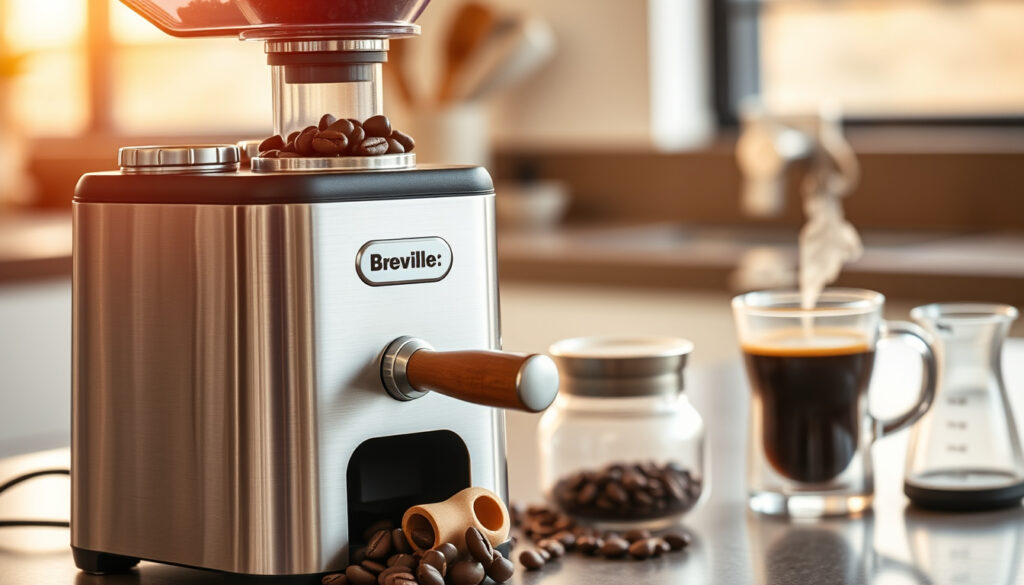
Breville Coffee Grinder Review: Are They Worth It
Anyone who’s spent a Saturday morning chasing the perfect espresso shot already knows: the grinder matters more than the machine. Breville has built a reputation around that idea, with conical burr grinders that aim to deliver consistent particles from espresso-fine to French press coarse. This guide breaks down Breville’s home grinder lineup, compares it head-to-head with De’Longhi, and answers the questions that keep coming up in forums and editorial reviews.
Grind settings: Up to 60 (Smart Grinder Pro) · Burr type: Stainless steel conical burr · Wattage: 165 W · Average lifespan: 5–7 years with regular use · Price range (USD): $100–$200 (home models)
Quick snapshot
- Breville home grinders use stainless steel conical burrs (TechGearLab product testing lab)
- Smart Grinder Pro has 60 grind settings (Coffeeness coffee equipment review)
- Exact lifespan without regular maintenance is not well documented (Choice Australia independent consumer test lab)
- Long-term reliability comparison with De’Longhi lacks controlled testing (Choice Australia independent consumer test lab)
- Latest models (Barista Touch, La Specialista Maestro) represent current generation of built-in grinders (Coffeeness coffee equipment review)
- Expect continued refinement in grind adjustment and digital controls from both brands
Five product specs that define Breville’s home grinder line:
| Spec | Value |
|---|---|
| Top-rated model | Breville Smart Grinder Pro (BCG820BSS) |
| Burr material | Stainless steel conical |
| Grind settings range | 1–60 (0.2 mm steps) |
| Bean hopper capacity | 12 oz (340 g) |
| Warranty | 1 year limited |
Are Breville coffee grinders any good?
Grind consistency
- Breville’s Smart Grinder Pro ranked top overall in one lab-tested guide, praised for consistent grinding and user-friendly interface (TechGearLab product testing lab).
- Conical burrs produce fewer fines than blade grinders, which matters for espresso extraction (Lifeboost Coffee espresso equipment guide).
The Smart Grinder Pro offers 60 stepped settings, allowing fine adjustment from Turkish-fine to French press coarse. In side-by-side tests, it consistently produces a uniform bed of grounds that extracts evenly (TechGearLab product testing lab).
Build quality
- Stainless steel burr carriers and metal gearbox in higher-end models indicate durable construction.
- Choice Australia gave Breville machines above-average scores on customer satisfaction (Choice Australia independent consumer test lab).
Breville grinders generally feel solid, though the plastic bean hopper on some models is a common detail. Long-term owners report that the burrs stay sharp for years with routine cleaning.
Value for money
- Prices range from $100 to $200 for standalone home grinders, undercutting many Italian brands.
- Lifeboost Coffee notes that the Barista Express and Bambino Plus are relatively easy for beginners to learn, adding value for new espresso enthusiasts (Lifeboost Coffee espresso education).
The trade-off: Breville delivers solid grind consistency at a competitive price, especially for home users who want espresso-capable adjustment without stepping into prosumer territory.
What are common problems with Breville grinders?
The same design that makes the Smart Grinder Pro easy to use also traps a little coffee inside. Regular cleaning is not optional—it’s the price of convenience.
Grind retention
Some users notice the Smart Grinder Pro holds back a small amount of ground coffee after each dose. One Reddit owner describes it as “a minor annoyance that’s easy to manage with a quick brush-out between coffee changes.”
Static clumping
Dry, cold beans can generate static electricity in the grind chamber, causing clumps that stick to the dosing cup. This is common in many conical burr grinders and is not unique to Breville. Spritzing the beans with a drop of water before grinding reduces clumping significantly.
Motor noise after extended use
Long-term owners occasionally mention increased motor noise after 3–5 years of daily use. Replacement burrs and a thorough cleaning usually restore quieter operation. The motor itself is rated for 165 watts—adequate for home use, but not built for commercial throughput.
The implication: these issues are more about maintenance than design flaws—and they’re manageable with a simple cleaning routine.
What is the best Breville grinder for home use?
Smart Grinder Pro
- 60 grind settings
- Stainless steel conical burr
- Dosing IQ technology adjusts time as burrs wear
The Smart Grinder Pro (BCG820BSS) is Breville’s most versatile home grinder, with 60 grind settings, a stainless steel conical burr, and Dosing IQ technology that adjusts grind time as the burrs wear (Coffeeness coffee equipment review). It handles everything from espresso to French press and has been the top overall pick in multiple buyer’s guides (TechGearLab product testing lab).
Smart Grinder Pro vs simpler models
The BCG600SII and Dose Control Pro are lower-cost alternatives with fewer settings and no digital timer. For most home users, the extra control of the Pro model justifies the price difference. If you only brew drip coffee, the Dose Control Pro’s 40 settings are more than enough.
Built-in grinder machines
Breville also offers espresso machines with integrated conical burr grinders, such as the Barista Express and Barista Pro. These combine grinding and brewing in one footprint, saving counter space without sacrificing grind quality (Coffeeness coffee equipment review).
The catch: the Smart Grinder Pro is the clear winner for versatility, but its size and price may be overkill for drip-only drinkers. The Dose Control Pro is a smart middle ground.
What is better, DeLonghi or Breville?
Three areas where these two brands diverge most clearly:
| Factor | Breville | De’Longhi |
|---|---|---|
| Grind adjustment | Finer step increments (60 settings on Smart Grinder Pro) (Coffeeness coffee equipment review) | Typically fewer settings; models like La Specialista Maestro offer assisted tamping (Coffeeness coffee equipment review) |
| Ease of use | Intuitive controls, faster to dial in (Lifeboost Coffee espresso equipment guide) | Emphasizes value and compact designs, some models have simpler interfaces (Lifeboost Coffee espresso equipment guide) |
| Reliability / Satisfaction | Higher average test scores and customer satisfaction (Choice Australia independent consumer test lab) | Slightly higher reliability scores in manual/semi-auto machines (Choice Australia independent consumer test lab) |
The pattern: Breville leads on precision and user experience; De’Longhi counters with value and a reliability edge that appeals to budget-conscious buyers.
What is the lifespan of a coffee grinder?
Factors affecting lifespan
- Daily use frequency, cleaning routine, and bean hardness all affect how long a grinder lasts.
- Burrs typically need replacement every 500–1000 pounds of coffee, depending on material.
Electric grinders average 5–7 years of service life (Choice Australia independent consumer test lab). Breville units often reach 5–10 years with proper care. Replacing the burrs at the midpoint can restore grind quality and extend usable life.
Breville-specific longevity
Owners on Reddit and forums report Breville grinders holding up well for 5+ years. The most common failure is the plastic gear that drives the hopper—easily replaced for about $20. Motor burnouts are rare in home use.
When to replace your grinder
Signs that a grinder is nearing the end: inconsistent grind size, excessive noise, or grounds clogging the chute. If cleaning and burr replacement don’t fix these, it’s time for a new unit.
The trade-off: spending a bit more upfront on a model with metal gears and replaceable burrs often doubles the machine’s useful life. The Smart Grinder Pro fits that profile.
Upsides
- Excellent grind consistency for the price (TechGearLab product testing lab)
- Wide setting range covers espresso to French press (Coffeeness coffee equipment review)
- User-friendly interface and Dosing IQ
- Stainless steel conical burrs are durable and easy to clean
Downsides
- Noticeable grind retention in Smart Grinder Pro
- Static clumping in dry conditions
- Plastic hopper can crack if dropped
- Motor noise may increase after 3–5 years
What we know for sure
- Breville uses stainless steel conical burrs in all home grinders (TechGearLab product testing lab)
- The Smart Grinder Pro has 60 grind settings (Coffeeness coffee equipment review)
What remains unclear
- Exact lifespan without regular maintenance is not documented in controlled studies
- Long-term reliability comparison with De’Longhi lacks independent head-to-head testing
We’ve recommended the Breville burr grinder for years. It has excellent grind quality and consistency.
— Serious Eats editorial review
Don’t listen to the naysayers, it is an awesome grinder. Just be aware it has some retention so clean it when you change coffee.
— Reddit user r/espresso
For the home espresso enthusiast looking to upgrade from a blade grinder, the choice is clear: the Breville Smart Grinder Pro delivers the precision you need without the price tag of a commercial unit. If you value simplicity over control, the Dose Control Pro is a capable step down. Skip De’Longhi’s grinders unless you find a reliability-focused deal—the Breville will likely serve you longer and grind more consistently, shot after shot.
For those considering a built-in grinder, our Breville Barista Pro review compares the Pro model’s integrated conical burr grinder with the standalone Breville grinders discussed here.
Frequently asked questions
Can you use a Breville grinder for Turkish coffee?
Only the finest settings (near 1) on the Smart Grinder Pro approach Turkish-fine, but most users find the grind still slightly coarser than traditional Turkish. For authentic Turkish, a manual grinder is preferred.
How often should you clean a Breville coffee grinder?
After every bag of beans, brush the burrs and chamber. A full disassembly and wash of removable parts every 4–6 weeks prevents oil buildup and stale flavors.
Does the Breville Smart Grinder Pro have a timer?
Yes, it features an adjustable digital timer that controls grind duration. You can set it in 0.1-second increments for precise dosing.
What is the difference between Breville and Sage grinders?
Breville and Sage are essentially the same brand—Sage is the name used in the UK, Australia, and New Zealand. Products are identical under different labels.
Are Breville grinder parts interchangeable between models?
No, burrs and hoppers vary by model. Only use parts designed for your specific model to avoid damage and safety issues.
Is it worth buying a refurbished Breville grinder?
If the refurbished unit includes a warranty and has been factory-cleaned, it can save 30–40%. Without a warranty, the risk of motor wear is higher.
How fine can the Breville grinder go for espresso?
Setting 1–8 on the Smart Grinder Pro produces espresso-fine grounds. Most users dial in around 4–6 for a balanced 25–30 second shot.
More related posts
 Unblocked G+ – School Proxies and Access Facts 2025
 Ralph Macchio: Age, Net Worth, Wife & Why He Looks So Young
 ABC Radio Melbourne – Frequency, Schedule, How to Listen
 Sarah Millican: Biography, Husband, and Netflix Special
 Guy Sebastian: Biography, Children, Nationality, and More
 Matty Healy: Taylor Swift, ADHD Diagnosis, and Sobriety
 The Idea of You: True Story, Harry Styles Link, Cast & Review
 Toilet Seat Buying Guide: Sizes, Types & Replacement Tips