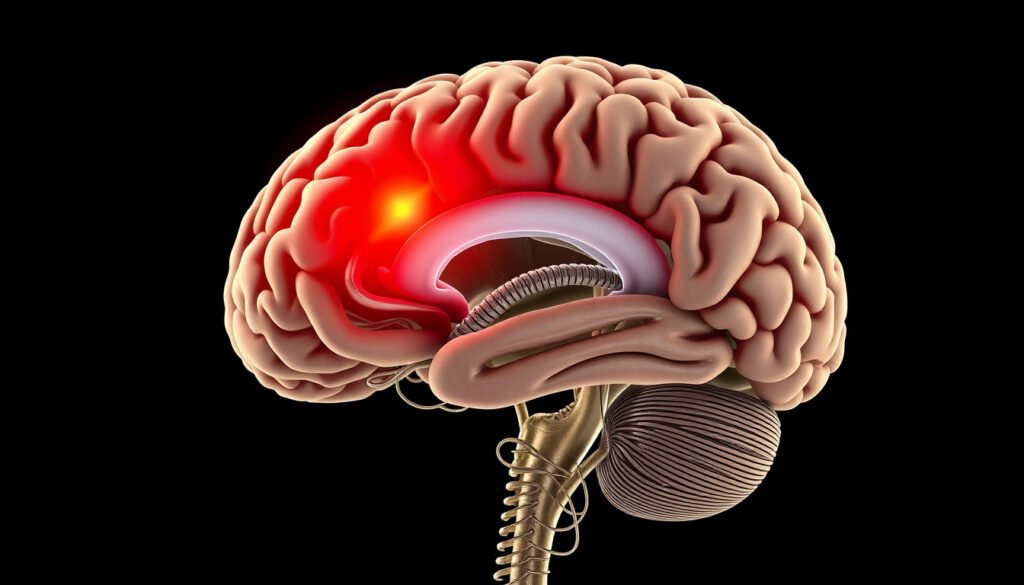
Brain Stem: Location, Function, and What Happens When Damaged
Few parts of the body are as essential and as hidden as the brain stem — tucked underneath the cerebrum, this slender stalk is the biological bridge that keeps us alive, regulating breathing, heartbeat, and consciousness without a single conscious thought. Measuring about 6–8 cm, it connects the cerebrum to the spinal cord and cerebellum, according to the NCBI Bookshelf (StatPearls).
Length of brain stem: approximately 6–8 cm (PMC (Indian perspective review)) ·
Number of cranial nerves connected: 10 of the 12 cranial nerves (NCBI StatPearls (midbrain)) ·
Main sections: 3 (midbrain, pons, medulla oblongata) (PMC (brainstem functions))
Quick snapshot
- The brainstem connects the cerebrum to the spinal cord and cerebellum (StatPearls)
- It regulates breathing, consciousness, blood pressure, heart rate, and sleep (Cleveland Clinic)
- The long-term effects of brainstem dysfunction on immune system regulation are not fully understood (PMC)
- The exact extent of the brain stem’s regenerative capacity in humans is not fully determined (Mayo Clinic)
- The reticular activating system, which provides the basis for wakeful consciousness, was described in the mid-20th century (PMC (Indian perspective review))
- Rehabilitation therapies can support recovery of function after brain stem injury, depending on severity (Mayo Clinic)
Five key facts about the brain stem, one pattern: each reinforces the structure’s role as the body’s non-negotiable command center.
The key facts below highlight the brain stem’s compact yet critical anatomy.
| Fact | Details |
|---|---|
| Total length | 6–8 cm |
| Number of cranial nerves | 10 of the 12 originate here |
| Number of sections | 3 (midbrain, pons, medulla) |
| Weight relative to whole brain | <1% |
| Location | Base of the brain, connecting to spinal cord |
| Core functions | Breathing, heart rate, blood pressure, consciousness, sleep |
| Key structures | Midbrain, pons, medulla oblongata; reticular formation |
| Blood supply | Vertebral and basilar arteries |
What is the brain stem?
The brain stem is the stalk-like structure that sits at the base of the brain, connecting the cerebrum to the spinal cord. It is about 6–8 cm long and accounts for less than 1% of the brain’s total weight, yet it controls the body’s most vital automatic functions. The brain stem is composed of three sections in descending order: midbrain, pons, and medulla oblongata (NCBI StatPearls (midbrain)).
What are the main parts of the brain stem?
- Midbrain: The uppermost section, involved in visual and auditory reflexes, and contains extrapyramidal structures important for movement regulation (NCBI Bookshelf (StatPearls)).
- Pons: The middle section, which houses the nuclei of several cranial nerves and serves as a relay station for signals between the cerebrum and cerebellum.
- Medulla oblongata: The lowest section, which contains the vital centers that control breathing, heartbeat, and blood pressure (PMC (Indian perspective review)).
The brain stem also has a three-layered functional organization: ventral basis, intermediate tegmentum, and dorsal tectum. The tegmentum contains the motor and sensory nuclei of cranial nerves III through XII, and the tegmental reticular formation is central to arousal, consciousness, and goal-directed behavior (PubMed (neuroanatomy review)).
What is another name for the brainstem?
In some contexts, the brainstem is simply called the “brain stem” (two words) or, in clinical literature, the “truncus encephali.” The term “brainstem” is used interchangeably with “brain stem” in modern neuroscience (PMC (brainstem functions)).
The brain stem’s small size belies its outsized role: without it, the brain’s connection to the body is severed, and life-sustaining reflexes vanish.
The implication: despite its tiny size, the brain stem commands life’s most fundamental processes.
What does the brain stem do?
The brain stem is the body’s automatic pilot. It regulates breathing, consciousness, blood pressure, heart rate, and sleep — all without conscious effort. It also relays sensory and motor signals between the brain and the body, and coordinates reflexes that keep us upright and safe (Cleveland Clinic).
How does the brain stem control breathing?
- The medulla oblongata contains the respiratory center, which automatically sets the rhythm and depth of breathing.
- The pons helps modulate that rhythm, adjusting breath rate based on feedback from the body (PMC (Indian perspective review)).
What is the role of the brain stem in heart rate regulation?
The medullary reticular formation contains the cardiac center, which adjusts heart rate and contractility through the autonomic nervous system. It also works with the vasomotor center to regulate blood pressure (PMC (brainstem dysfunction)).
The reticular activating system, which runs through the brain stem, provides the anatomical and physiological basis for wakeful consciousness. Damage to this system can lead to loss of cognition, persistent unconsciousness, and coma (PubMed (neuroanatomy review)).
The brain stem controls everything we never think about — breathing, heartbeat, wakefulness — yet it does so with a mass smaller than your thumb. Its efficiency is also its vulnerability.
What this means: the brain stem’s automatic processes are the bedrock of consciousness; even a small disruption can erase awareness.
What happens if the brain stem is damaged?
Because the brain stem is small and tightly packed with critical structures, even minor damage can have catastrophic consequences. Small lesions can destroy vital cardiac and respiratory centers and disconnect the cerebral cortex from the brain stem (PMC (Indian perspective review)).
What causes brain stem damage?
- Blood clots, encephalitis, heart attack, or sudden cardiac arrest (Cleveland Clinic)
- Brain stem tumors, which can affect movement, balance, coordination, sensation, speech, or basic body functions (Mayo Clinic)
- Traumatic brain injury, stroke, or infection
What are the symptoms of brain stem damage?
Brain stem dysfunction may cause sensory and motor deficits, cranial nerve palsies, impaired consciousness, dysautonomia, and respiratory failure (PMC (brainstem dysfunction)). One of the most severe outcomes is locked-in syndrome, where the person is fully conscious but unable to move any muscle except the eyes. Brain stem death is a legal definition of death in many jurisdictions, meaning the irreversible loss of brain stem function even if the heart continues to beat with life support.
The implication: damage to the brain stem is not just about cognitive impairment — it’s about losing the biological reflexes that keep us alive.
How long does it take for the brain stem to heal?
Healing depends heavily on the severity of the injury. Mild injuries, such as those from concussion or minor stroke, may improve over weeks to months. Severe damage, however, is often permanent because the brain stem has limited regenerative capacity (Mayo Clinic).
- Initial stabilization and treatment of the underlying cause — e.g., clot retrieval for stroke, surgery for tumors, or supportive care for trauma.
- Neurorehabilitation therapies — physical, occupational, and speech therapy help the brain and body adapt to remaining function.
- Long‑term adaptation and supportive care — managing symptoms, preventing complications, and maximizing quality of life through assistive devices or medications.
Is it possible to improve brain stem function?
- Rehabilitation therapies — including physical, occupational, and speech therapy — can help the brain and body adapt to remaining function.
- Neuroplasticity allows other parts of the brain to take over some functions, but the brain stem itself does not regenerate neurons effectively.
What treatments help brain stem injuries?
Treatment depends on the underlying cause. For stroke, thrombolysis or clot retrieval may be used. For tumors, surgery or radiation. For traumatic injury, stabilization and supportive care. There is no specific medication to “heal” the brain stem; recovery focuses on neurorehabilitation and managing symptoms (PMC (brainstem functions)).
The trade-off: mild injuries often recover surprisingly well with therapy, but severe injuries leave lasting deficits that require lifelong adaptation.
Can you live without a brain stem?
No. Life is not possible without a functioning brain stem. It controls the automatic functions that sustain life, and its destruction is irreversible.
What is brain stem death?
Brain stem death is a clinical diagnosis of death based on the irreversible loss of all brain stem reflexes and the ability to breathe independently. It is accepted as legal death in the UK, the US, and most other countries.
How is brain stem death determined?
Diagnosis involves two independent doctors performing tests to confirm that the brain stem is no longer functioning. These tests include checking for pupillary response, corneal reflex, gag reflex, and the absence of spontaneous breathing. The criteria were formally established in the UK in 1995 and are widely adopted (StatPearls).
For patients and families, the diagnosis means that the person is clinically dead, even if the heart continues to beat with mechanical ventilation. The decision to continue or withdraw life support is based on this legal and medical definition.
“The brainstem is the only part of the brain that is absolutely essential for life.”
Cleveland Clinic
“Brain stem death is the irreversible loss of the capacity for consciousness combined with the irreversible loss of the capacity to breathe.”
StatPearls (NCBI Bookshelf)
“Small lesions in the brainstem can destroy vital cardiac and respiratory centers and disconnect the cerebral cortex from the brainstem.”
PMC (Indian perspective review)
For clinicians, researchers, and anyone facing a brain stem injury, the message is clear: the brain stem is the body’s non-negotiable biological bridge. Protecting it — through prevention, rapid treatment, and rehabilitation — is a matter of life and death.
simplypsychology.org, academic.oup.com, mhcc.pressbooks.pub, en.wikipedia.org
For a more detailed look at the brain stem anatomy and function, including its role in regulating vital processes, see brain stem anatomy and function.
Frequently asked questions
What is the difference between brain stem and spinal cord?
The brain stem connects the brain to the spinal cord and contains cranial nerve nuclei and vital centers for breathing and heart rate. The spinal cord carries signals between the brain and the rest of the body and controls reflexes below the neck.
Can brain stem damage cause memory loss?
Yes, damage to the reticular formation can impair consciousness and attention, which indirectly affects memory. However, the brain stem itself is not the primary site for memory storage.
Is brain stem injury always fatal?
Not always. Mild injuries may recover, but severe damage, especially to the medulla, can be fatal because it controls breathing and heartbeat.
How is a brain stem stroke treated?
Treatment includes clot-dissolving drugs, mechanical clot removal, and supportive care. Rehabilitation is crucial for recovery of function.
Does concussion affect the brain stem?
Concussion can affect the brain stem, especially the reticular activating system, leading to temporary loss of consciousness or confusion.
Are there exercises to strengthen the brain stem?
No specific exercises strengthen the brain stem, but activities that improve balance, coordination, and breathing (e.g., yoga, tai chi) may support its function indirectly.
What does a pinched brain stem feel like?
Compression of the brain stem can cause headache, dizziness, double vision, difficulty swallowing, weakness, and loss of consciousness.
More related posts
 Diane Farr: Life After Numb3rs, Voice Loss, and Net Worth
 Adelaide to Sydney – Distance, Time, Costs and Best Routes
 Dennis Lillee: Legendary Fast Bowler, Injury Comeback, and Life Today
 Mark Dreyfus: Biography, Career, Family and Recent Absence
 Phillip Island Wildlife Park: Hand-Feed Kangaroos, Tickets, Hours
 How Many Millions in a Billion? UK vs US Definitions Explained
 Nikolaj Coster-Waldau: Languages, Net Worth, Facts
 AirPods 4 Noise Cancelling: How to Use, Is It Worth the Cost?