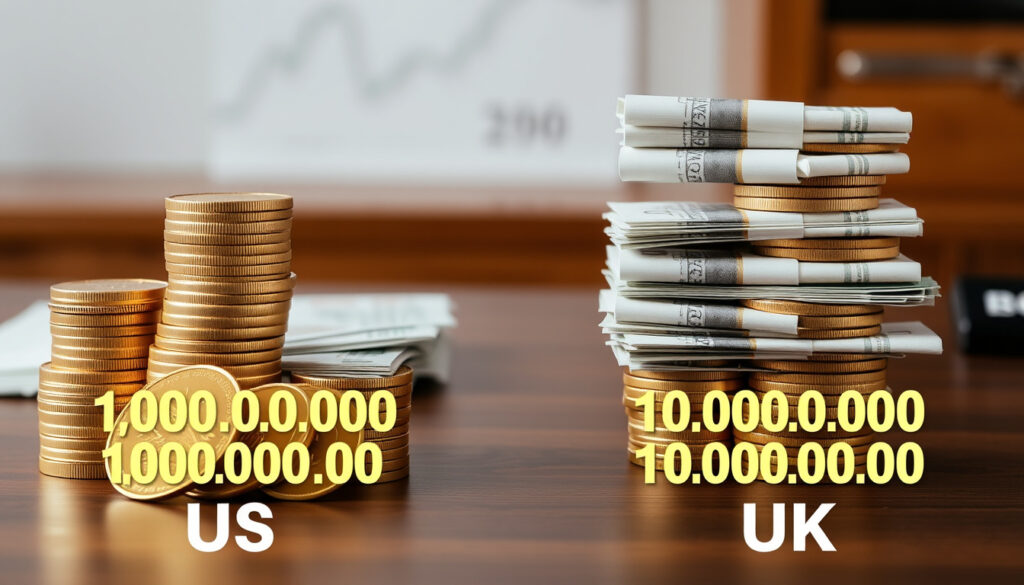
How Many Millions in a Billion? UK vs US Definitions Explained
If you’ve ever tried to count the zeros in a billion and ended up slightly dizzy, you’re not alone — the answer “1,000” is simple, but the story behind that number twists through centuries of language, politics, and math. Here’s the clear, source-backed breakdown of what a billion really means today and why it used to mean something very different.
Million defined: 1,000,000 (10^6) ·
Billion (short scale): 1,000,000,000 (10^9) ·
Millions in one billion: 1,000 ·
UK adopted short scale: 1974
Quick snapshot
- Modern UK definition: 1 billion = 1,000 million (short scale) (The Better Editor (language and usage blog))
- US definition has always been short scale (Wikipedia (encyclopedic reference))
- 1 trillion = 1,000 billion (short scale) (Smartick (educational math platform))
- Some older British sources still use long scale, but rare in modern official use (Wikipedia (encyclopedic reference))
- 1974: UK switched to short scale (The Better Editor (language and usage blog))
- Global convergence on short scale continues; long scale persists in some European languages (Smartick (educational math platform))
Five key facts about the million-billion relationship, drawn from official and educational sources:
| Fact | Value |
|---|---|
| Number of millions in one billion | 1,000 |
| Number of billions in one trillion | 1,000 |
| Year UK adopted short scale | 1974 |
| Long scale billion value | 1,000,000,000,000 (10¹²) |
| Short scale billion value | 1,000,000,000 (10⁹) |
How many millions is a billion in the UK?
Since 1974, the official UK definition of a billion is 1,000 million — exactly the same as the US definition. That means the number 1,000,000,000 contains 1,000 groups of 1,000,000 each. The UK government, the BBC, and most British media use this short‑scale definition today (The Better Editor (language and usage blog)).
Short scale vs long scale explained
- Short scale (used in the US and modern UK): million (10⁶), billion (10⁹), trillion (10¹²) — each step multiplies by 1,000 (Smartick (educational math platform)).
- Long scale (historic British and still used in some European countries): million (10⁶), thousand million / milliard (10⁹), billion (10¹²) — each step multiplies by 1,000,000 (Arithmetic – Names of large numbers (reference archive)).
What this means: Under the long scale, a billion was 1,000,000 million — a million times bigger than the short‑scale billion. That’s a difference of three orders of magnitude.
If you read a pre‑1974 British book that talks about “billions,” it’s likely using the long scale — meaning the numbers are vastly larger than what modern readers expect.
When the UK switched to the short scale
In December 1974, Prime Minister Harold Wilson announced that UK government statistics would use the short scale. The BBC and other major outlets followed within a few years (The Better Editor (language and usage blog)). A 2006 UK Treasury document confirmed that “billion” now means 1,000 million in all official communications.
The implication: Anyone born after the mid‑1970s in the UK has only ever known the short‑scale billion. The long scale survives mostly in historical texts and in languages like French, German, and Spanish (where “milliard” is used for 10⁹) (Wikipedia (encyclopedic reference)).
How many millions for 1 billion?
Simple multiplication: 1,000,000 (one million) × 1,000 = 1,000,000,000 (one billion). That’s the short‑scale answer used universally in English‑speaking countries today.
The simple math: 1,000 millions = 1 billion
- 1 million = 1,000,000 (10⁶)
- 1 billion = 1,000,000,000 (10⁹)
- To go from millions to billions, divide by 1,000. To go from billions to millions, multiply by 1,000.
“In the short scale, 1 billion equals 1,000 million.”
— The Better Editor (language and usage blog)
Comparison chart: million vs billion vs trillion
One table shows how the three magnitudes stack up on the short scale:
| Name | Value | Number of millions | Number of billions |
|---|---|---|---|
| Million | 1,000,000 | 1 | 0.001 |
| Billion | 1,000,000,000 | 1,000 | 1 |
| Trillion | 1,000,000,000,000 | 1,000,000 | 1,000 |
The pattern: Each step is 1,000 times the previous. A trillion is 1,000 billion — and 1,000,000 million.
Do 100 million make a billion?
No. 100 million is only one‑tenth of a billion. This is a common misconception because “billion” sounds vaguely like “million” — but the number of zeros tells the real story.
Why 100 million is only a tenth of a billion
- 100 million = 100,000,000 (10⁸)
- 1 billion = 1,000,000,000 (10⁹)
- It takes 10 times 100 million to reach 1 billion (Smartick (educational math platform)).
Example: If you saved $100 million, you’d need to repeat that feat nine more times to become a billionaire.
Misunderstanding this scale can distort budget debates, business valuations, and public policy discussions — a $100 million program is not remotely a $1 billion program.
Examples of the scale difference
To put it in concrete terms: A million seconds is about 11.5 days. A billion seconds is about 31.7 years. That’s a 1,000‑fold gap — and even 100 million seconds is only 3.17 years. The difference between 100 million and 1 billion is the same as the difference between a long weekend and a career.
The trade-off: When you hear “hundreds of millions” vs. “billions,” remember the factor of ten — it’s the difference between a large company and a mega‑corporation.
How many billions is a trillion?
On the short scale, 1,000 billions make one trillion (10¹²).
Trillion definition on short scale
- 1 trillion = 1,000,000,000,000
- That’s 1,000 billion or 1,000,000 million.
- The short scale sequence continues: quadrillion = 1,000 trillion, and so on (Arithmetic – Names of large numbers (reference archive)).
Visualizing a trillion using real-world comparisons
A trillion dollars stacked in $100 bills would reach into space — about 63 miles high. To spend $1 trillion at $1 per second would take 31,689 years. That’s 1,000 times the spending power of a billion-dollar fortune.
“In short scale a trillion is a thousand billion, while in long scale a trillion is a million million million.”
— Arithmetic – Names of large numbers (reference archive)
The pattern: Each new “-illion” on the short scale adds three zeros — an intuitive system that makes large‑number arithmetic straightforward once you understand the base.
Is there a difference between a British billion and an American billion?
Today, no. Both countries use the short scale (billion = 10⁹). But historically, the British billion was a million million (10¹²) — 1,000 times larger than the American version.
History of the long scale billion
- The long scale originated in 15th‑century France (Wikipedia (encyclopedic reference)).
- It spread to British English, where “billion” meant 10¹² for centuries.
- In the 1920s, the United States adopted the short scale, while the UK stuck with the long scale until 1974 (The Better Editor (language and usage blog)).
This created a transatlantic confusion that persisted for decades. A British journalist in the 1960s writing about a “billion‑dollar budget” meant something 1,000 times larger than an American reader would assume.
Current convergence on short scale
Since the UK’s 1974 switch, the English‑speaking world is unified on the short scale. The only lingering confusion comes from older publications and from other languages (French, Spanish, German) that still use the long scale or a hybrid system (Smartick (educational math platform)).
If you hear “billion” in a modern English context — whether from London, New York, Sydney, or Toronto — the number is 1,000 million. The historical ambiguity is, for practical purposes, resolved.
The convergence means no translation is needed between the US and UK today.
Timeline of the billion
- 15th century: Long scale originates in France, used in British English for centuries. (Wikipedia (encyclopedic reference))
- 1920s: US adopts short scale; billion = 1,000 million. (Wikipedia (encyclopedic reference))
- 1974: UK Prime Minister Harold Wilson announces switch to short scale. (The Better Editor (language and usage blog))
- 2006: UK Treasury confirms billion = 1,000 million in official statistics. (The Better Editor (language and usage blog))
The implication: The modern billion is a relatively recent consensus — barely 50 years old in the UK.
What we know for sure and what remains fuzzy
Confirmed facts
- Modern UK definition: 1 billion = 1,000 million (short scale) (The Better Editor (language and usage blog)).
- US definition has always been short scale (Wikipedia (encyclopedic reference)).
- 1 trillion = 1,000 billion (short scale) (Smartick (educational math platform)).
What’s unclear
- Some older British sources still use long scale, but rare in modern official use (Wikipedia (encyclopedic reference)).
For practical purposes, the short scale is the standard across the English-speaking world.
Expert perspectives on the billion debate
“Since late 1974, short-scale usage has been official and correct in UK government communications.”
— UK Parliament research briefing (Commons Library), as cited by The Better Editor
“The BBC and other UK media followed the post-1974 shift fairly quickly.”
— The Better Editor (language and usage blog)
Bottom line
For anyone working with large numbers in English today, the answer is unambiguous: 1,000 millions make one billion. The long‑scale billion is a historical artifact, still alive in some languages but dead in English. For UK readers reading pre‑1974 texts — or for anyone translating budgets from French or German — the scaling factor of 1,000 is the difference between a modest fund and an astronomical one. Know your scale, or risk being off by a factor of a thousand.
Related coverage: the short scale billion definition fördjupar bilden av How Much Is a Billion – Everyday Examples and Facts.
Frequently asked questions
How many zeros are in a billion?
Nine zeros: 1,000,000,000.
Is 1 billion equal to 100 crores?
No. 1 billion (short scale) = 100 crores (Indian numbering system). 100 crores = 1,000,000,000, so it matches the short‑scale billion but uses a different name.
How many millions in a trillion?
1,000,000 million on the short scale.
What is a million million called?
On the short scale, a million million is a trillion. On the long scale, it’s a billion.
Does the UK still use the long scale for any numbers?
Not in official usage. Some older reference works may use it, but modern British English follows the short scale.
Why did the UK change to the short scale?
To align with international financial and statistical standards and reduce confusion with the US, which had been using the short scale since the 1920s.
How many billions are in a quadrillion?
1,000 billions in a quadrillion on the short scale (1 quadrillion = 10¹⁵).
More related posts
 Why Was Little Fires Everywhere Banned? Controversy & Story
 Scotty Cam: Real Name, Background, Net Worth & The Block Host
 Ted Kaczynski: Unabomber IQ, Death, Brother Facts
 Emily VanCamp: Biography, Net Worth, Husband, and More
 Pokemon Go Plus – Setup Guide, Battery Life and 2025 Review
 Raymond Ablack: Ethnicity, Parents & Ginny & Georgia Role
 Canberra to Sydney: Flights, Train, Bus & Drive Guide
 Lord Byron: Biography, Works, Exile, and Scandalous Life