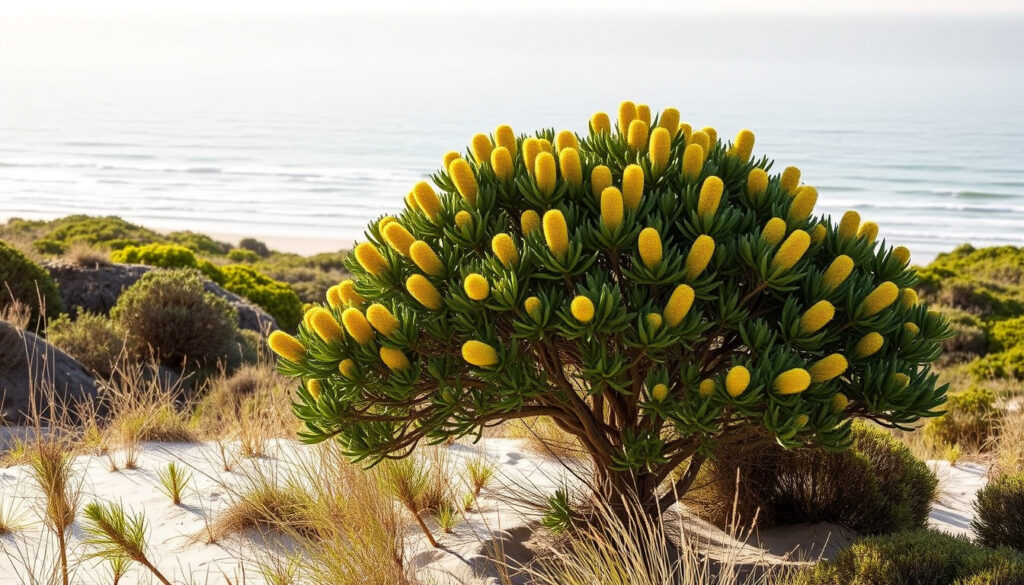
Banksia integrifolia: Coast Banksia Care, Pruning & Growing Guide
Anyone who has tried to grow a flowering tree in a seaside garden knows the struggle: sandy soil, salt spray, and wind that would make most plants wither. Banksia integrifolia, the Coast Banksia, has been thriving in exactly those conditions along Australia’s eastern coastline for millennia.
Typical mature height: 10–15 m (33–49 ft) ·
Growth rate: Slow to moderate ·
Hardiness (USDA equivalent): Zones 9–11 ·
Flowering period: Autumn to early summer (mainly Jan–Jun) ·
Soil preference: Well-drained, sandy, low phosphorus ·
Lifespan: 50–100+ years
Quick snapshot
- Evergreen tree up to 15 m (Australian National Botanic Gardens)
- Obovate leaves 4–10 cm (Australian National Botanic Gardens)
- Lemon-yellow flower spikes Jan–Jun (Australian National Botanic Gardens)
- Full sun to part shade (Australian National Botanic Gardens)
- Well-drained sandy loam (Australian National Botanic Gardens)
- Tolerates salt spray and coastal winds (Australian National Botanic Gardens)
- Slow to moderate growth (Seasol – Australian native plant guide)
- Low phosphorus fertilizer only (Seasol – Australian native plant guide)
- Light pruning after flowering (Seasol – Australian native plant guide)
- Attracts birds and bees
- Provides coastal erosion control
- Long-lived (50–100+ years)
Eight key facts, one pattern: this is a tree built for tough coastal sites, with moderate size and a long lifespan.
| Attribute | Value |
|---|---|
| Scientific name | Banksia integrifolia |
| Common name | Coast Banksia |
| Family | Proteaceae |
| Origin | East coast of Australia |
| Mature height | 10–15 m (33–49 ft) |
| Mature width | 3–5 m (10–16 ft) |
| USDA hardiness | Zones 9–11 |
| Soil pH | 5.5–7.0 |
How big does Banksia integrifolia grow?
Typical height and width in gardens
In an open garden setting, Banksia integrifolia reaches a mature height of 10–15 m (33–49 ft) with a spread of 3–5 m (10–16 ft), according to the Australian National Botanic Gardens. The tree’s size can vary significantly with growing conditions: in poor sandy soils it may stay smaller, while in richer loam it can approach the upper end of its range. Dwarf cultivars such as ‘Sentinel’ and ‘Mini’ stay under 2 m, making them suitable for smaller gardens.
Growth rate and time to maturity
Growth is slow to moderate, averaging 30–60 cm per year under ideal conditions. The Gardenia.net horticultural guide notes that it takes roughly 10 years to reach 5–6 m, and full size is attained after 20–30 years. This slow pace makes it a manageable tree for most residential blocks, provided you plan for its eventual width.
A 10–15 m tree in a 6 m front yard means either regular pruning or a dwarf selection. The trade-off: slower growth buys you time to shape it.
The implication: if you want a quick screen, look elsewhere. For a long-lived specimen that won’t outgrow its space for decades, the Coast Banksia delivers.
Can you prune Banksia integrifolia?
When and how to prune
Prune lightly, preferably after flowering (late summer to early autumn). The Seasol Australian native plant guide recommends tip-pruning young plants for the first two years to encourage bushy growth. For established trees, remove dead, crossing, or poorly placed branches to create a stronger framework (Gardenia.net).
Pruning for size control
Hard renovation pruning into old bare wood is discouraged because recovery depends on active buds. The Botanic Gardens of South Australia plant selector warns that pruning too hard into old wood can cause permanent damage. However, mature plants with a well-developed lignotuber may respond well to hard rejuvenation pruning (Seasol).
Prune too much and you get heavy leaf growth at the expense of flowers. The Botanic Gardens of South Australia explicitly warns that over-pruning sacrifices blooms.
The pattern: regular light pruning after flowering keeps the tree compact and flowering well. One heavy cut can set you back two seasons.
Is Banksia integrifolia frost hardy?
Minimum temperature tolerance
Established plants tolerate light frost down to about -5°C (23°F), especially in sharply drained soil, according to Gardenia.net. Some garden guidance from Promesse de Fleurs suggests mature plants may survive brief frosts of -7°C to -10°C in dry soil, but this is riskier.
Protection in cold climates
Young plants are more vulnerable than established ones. The Australian National Botanic Gardens advises protecting young banksias during their first years in cold regions. A Bonsai Society of Victoria source recommends keeping plenty of foliage over winter and avoiding wet potting mix for extended periods in colder climates.
The trade-off: the Coast Banksia can handle a light frost, but planting it in a frost pocket or heavy clay soil that stays wet in winter is asking for trouble.
Do Banksias have invasive roots?
Root system characteristics
Banksia integrifolia has a non-invasive, fibrous root system. The Australian National Botanic Gardens describes the roots as spreading shallowly, making the tree safe near paths and foundations. Unlike some Australian natives (e.g., eucalypts), Coast Banksia does not produce aggressive taproots or surface roots that crack concrete.
Safe planting distances
Because the roots are fibrous and not invasive, you can plant as close as 2–3 m from structures without worry. The Botanic Gardens of South Australia confirms it is a good choice for urban landscapes. The only caution: ensure the soil is well-drained to avoid root rot, which is the real threat to banksias in heavy soils.
What this means: if you’ve been avoiding native trees because of root horror stories, the Coast Banksia is a safe bet for suburban gardens.
What are the cons of Banksia integrifolia?
Potential drawbacks
- Phosphorus sensitivity: Banksias evolved in low-phosphorus soils and can suffer fertilizer burn if given standard garden feeds (Seasol).
- Messy flowers: The large, woody cones and spent flower spikes drop and can create garden litter.
- Size: Without pruning, the tree can reach 15 m, which may be too large for small urban lots.
Disease and pest issues
- Root rot (Phytophthora): Common in heavy, poorly drained soils. The Australian National Botanic Gardens notes that good drainage is the single most important factor for health.
- Scale insects and caterpillars: Occasionally attack but rarely cause serious damage on healthy trees.
The main con is not the tree itself—it’s the soil. Give it the wrong drainage or the wrong fertilizer, and you’ll fight problems from day one. Get those right, and the Coast Banksia is remarkably low-maintenance.
The pattern: the Coast Banksia’s vulnerabilities are almost entirely soil-related. No soil issues? No real cons.
Specifications
Ten attributes, one pattern: every number points to a tree that’s moderate, tough, and adapted to low-fertility coastlines.
| Specification | Detail |
|---|---|
| Scientific name | Banksia integrifolia |
| Common name | Coast Banksia |
| Family | Proteaceae |
| Origin | East coast of Australia |
| Mature height | 10–15 m (33–49 ft) |
| Mature width | 3–5 m (10–16 ft) |
| Growth rate | Slow to moderate (30–60 cm/year) |
| USDA hardiness | Zones 9–11 |
| Soil pH | 5.5–7.0 (acidic to neutral) |
| Flowering period | January to June (peak autumn–early summer) |
| Lifespan | 50–100+ years |
| Drought tolerance | Moderate (once established) |
Pros and Cons
Upsides
- Excellent salt tolerance for coastal gardens
- Non-invasive, fibrous root system
- Attracts birds, bees, and beneficial insects
- Long-lived (50–100+ years)
- Dwarf cultivars available for small spaces
Downsides
- Phosphorus sensitive – requires special fertilizer
- Can be messy with dropping flowers and cones
- Susceptible to root rot in heavy clay soils
- Slow growth – not a quick screen
- Hard pruning can damage the tree
Step-by-step: Planting and care timeline
For a gardener who wants to plant a Coast Banksia and see it thrive, here’s a year-by-year road map based on advice from the Australian National Botanic Gardens and Seasol.
- Year 1 – Establishment: Water regularly during dry spells, apply a layer of organic mulch (keep away from trunk), and do not fertilize. Let the roots explore the native soil.
- Year 2–3 – First prune: After flowering, tip-prune young shoots to encourage branching. Remove any dead or crossing wood. Start a light annual feed with low-phosphorus native fertilizer.
- Year 4–5 – Flowering begins: You should see the first lemon-yellow spikes. Continue annual pruning after flowering. Switch to a native-specific slow-release fertilizer if needed.
- Year 10+ – Mature tree: Minimal care; water only in prolonged drought. Prune every 2–3 years to maintain shape. Monitor for root rot if drainage changes.
Confirmed facts vs. What’s unclear
Confirmed facts
- Banksia integrifolia is native to the east coast of Australia (Australian National Botanic Gardens).
- It grows well in sandy, well-drained soils (Australian National Botanic Gardens).
- It is frost tolerant down to about -5°C (Gardenia.net).
- It has non-invasive roots (Botanic Gardens of South Australia).
What’s unclear
- Exact lifespan in suburban gardens versus natural habitat – may differ due to soil compaction and irrigation.
- Long-term performance of dwarf cultivars in cold inland areas – limited data from inland trials.
- Whether the -7°C to -10°C frost tolerance reported by some sources applies reliably across all soil types.
Expert perspectives
“Banksia integrifolia is a very adaptable species, occurring in a wide range of habitats from coastal dunes to mountain forests.”
“Prune lightly after flowering to maintain a compact shape. Avoid cutting into old wood without active buds.”
“Banksias require perfect drainage and low-phosphorus fertiliser because they evolved in low-phosphorus soils.”
“Responds well to light pruning, but too much can produce heavy leaf growth at the expense of flowers.”
Summary
Banksia integrifolia is a tree that asks for very little—good drainage, low phosphorus, and a light touch with the secateurs—and gives back decades of coastal resilience, wildlife habitat, and understated beauty. For the Australian gardener on a sandy block near the sea, the choice is clear: plant a Coast Banksia, or spend the next 20 years wishing you had.
ccgit.crown.edu, leaftide.com, aussiegreenthumb.com, ausbonsai.com.au, gardenexpress.com.au, ssgscaffolding.co.uk
For a more detailed guide on Coast Banksia size and roots, see detailed guide on Coast Banksia size and roots.
Frequently asked questions
When does Banksia integrifolia flower?
Flowering occurs mainly from January to June, with peak blooms in autumn and early winter. The lemon-yellow spikes can appear sporadically at other times depending on climate.
How fast does Banksia integrifolia grow?
Growth is slow to moderate, averaging 30–60 cm per year. It takes about 10 years to reach 5–6 m, and full size (10–15 m) is achieved after 20–30 years.
What fertilizer should I use for Banksia integrifolia?
Use a low-phosphorus native plant fertilizer. Standard garden fertilizers are high in phosphorus and can cause leaf burn and root damage. Seasol or a similar seaweed-based product is safe.
Can Banksia integrifolia grow in pots?
Yes, dwarf cultivars like ‘Sentinel’ or ‘Mini’ grow well in large pots (50 cm diameter minimum). Use a well-draining native potting mix and water sparingly in winter.
Does Banksia integrifolia attract birds?
Yes—the nectar-rich flowers attract honeyeaters, lorikeets, and other native birds. The tree also provides habitat for insects and small mammals.
Is Banksia integrifolia toxic to pets?
There are no known reports of toxicity to dogs or cats. The flowers and cones are not considered poisonous, but ingestion of large amounts could cause mild digestive upset.
How do you propagate Banksia integrifolia from seed?
Seeds require no pretreatment; simply sow them in well-drained seed-raising mix, keep moist, and place in a warm, sunny spot. Germination takes 2–6 weeks. Transplant seedlings when they reach 10–15 cm.
More related posts
 Pat Cummins Injury, IPL 2026 Return, Net Worth, and Wife
 Is Animal Jam Still Playable? A Complete Guide for 2025
 Diary of a Wimpy Kid: Guide to Books, Age, and Order (2025)
 Australia v South Africa: Rugby & Cricket Guide 2025
 Jessica Osbourne: Who She Is, Why She Skipped Ozzy’s Funeral
 Coffee Shops Near Me: Best Coffee Spots in Ireland
 Julia Garner: Health Rumors, Net Worth, and Jennifer Garner
 George Wendt Dies at 76: Cause of Death & Tributes