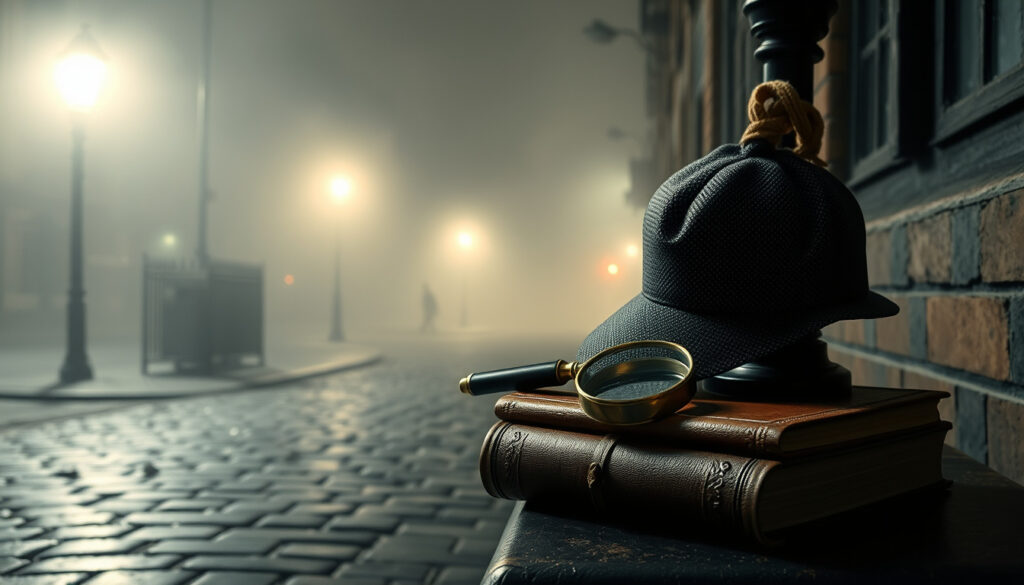
Sherlock Holmes: The Fictional Detective Behind the Legend
You know the name Sherlock Holmes. But did you know the most famous line attributed to him — “Elementary, my dear Watson” — never actually appears in the original stories? (No Film School analysis) That’s just one of many surprises in the legacy of Arthur Conan Doyle’s iconic detective. This fact-checked guide untangles the real from the fictional, from 221B Baker Street to the man himself.
First appearance: 1887 in A Study in Scarlet · Total stories: 4 novels and 56 short stories1 · Number of film/TV adaptations: over 250 · Creator: Sir Arthur Conan Doyle · Famous address: 221B Baker Street, London
Quick snapshot
- Created by Sir Arthur Conan Doyle (Encyclopaedia Britannica biography)
- First appeared in 1887 in A Study in Scarlet (Encyclopaedia Britannica)
- Lives at 221B Baker Street with Dr. Watson (Baker Street Wiki)
- Canon begins with A Study in Scarlet (Baker Street Wiki)
- Helped create one of the most enduring characters in English fiction (Encyclopaedia Britannica)
- “Elementary, my dear Watson” is a pop-culture invention, not a canon line (No Film School)
- 221B Baker Street is a real museum address (Sherlock Holmes Museum official site)
- 2009 film adaptation starring Robert Downey Jr. (IMDb quotes)
- Ongoing debate about Holmes’s sexuality stems from canon silence (Content plan) (IMDb quotes)
| Attribute | Detail |
|---|---|
| Full name | Sherlock Holmes |
| Occupation | Consulting detective |
| Creator | Sir Arthur Conan Doyle |
| First appearance | 1887 – A Study in Scarlet |
| Number of stories | 60 (4 novels, 56 short stories) |
| Address | 221B Baker Street, London |
| Known for | Deductive reasoning, logical thinking, disguise |
The table above distills the core identifiers of the character into a single reference point.
Is Sherlock Holmes based on a true story?
No — Sherlock Holmes is a fictional character, not a real historical person. Sir Arthur Conan Doyle created him as a pure invention, though he drew inspiration from a former teacher with sharp observational skills.(Encyclopaedia Britannica, biography)
Who was the real-life inspiration for Sherlock Holmes?
- Conan Doyle’s medical professor Dr. Joseph Bell was known for his keen diagnostic observations. Conan Doyle later said Bell’s methods were the model for Holmes’s deductive approach.(Encyclopaedia Britannica)
- Other influences include the fictional detective Auguste Dupin by Edgar Allan Poe and the real detective work of early Scotland Yard figures.
Did Arthur Conan Doyle know a detective like Holmes?
Conan Doyle had no direct experience with professional detectives, but he did study medicine and worked as a physician. The analytical reasoning he admired in Dr. Bell became the hallmark of Holmes’s character.(Encyclopaedia Britannica)
Sherlock Holmes is as fictional as Dr. Watson, but his creator used real-world logic and observation to make him feel uncannily real. For readers looking for a true crime figure: none exists — the closest you’ll get is Dr. Joseph Bell.
What this means: the detective you see in books and on screen is a literary construct, not a historical record. The power of his method is that it could be real.
Why is Sherlock Holmes so famous?
Holmes’s fame rests on a mix of innovative storytelling, groundbreaking forensic methods, and a charismatic character that transcended the page. The stories were serialized in The Strand Magazine and reached a massive audience at a time when literacy and leisure reading were booming.(Encyclopaedia Britannica)
What made Sherlock Holmes revolutionary?
- Holmes used deductive reasoning and forensic science long before modern crime labs existed — he analyzed cigar ash, footprints, and handwriting.
- The character introduced the concept of the “consulting detective,” which influenced later fictional investigators and even real police methods.(Encyclopaedia Britannica)
- The relationship between Holmes and Watson set the template for the brilliant detective and the loyal sidekick.
How did Holmes influence detective fiction?
Before Holmes, detective stories were often about amateur sleuths or police officials. Holmes professionalized detection, making it a science. His methods were so influential that many early criminologists cited him as an inspiration.(Encyclopaedia Britannica)
Sherlock Holmes didn’t just entertain — he changed how we think about solving problems. For anyone curious about the roots of modern forensic science, Holmes is part of the foundation.
What is Sherlock’s most famous saying?
The line everyone associates with Holmes — “Elementary, my dear Watson” — never appears in any of Conan Doyle’s original stories. (No Film School) It first appeared in a 1929 film adaptation starring Clive Brook.(No Film School)
Did Sherlock Holmes ever say ‘Elementary, my dear Watson’?
No — the closest the canon gets is Holmes saying “Elementary” in a few stories, and “my dear Watson” many times, but never as a single phrase. The combined catchphrase was invented by scriptwriters.(No Film School)
What are other famous quotes by Holmes?
- “When you have eliminated the impossible, whatever remains, however improbable, must be the truth.” — The Sign of Four (Best of Sherlock)
- “You see, but you do not observe.” — A Scandal in Bohemia (Sherlock Holmes Quotes)
- “The game is afoot.” — used in multiple stories as his call to action.
The most iconic phrase is also the most misattributed. For fans, this means the real Holmes canon is full of equally sharp lines that are less famous but more authentic.
Does 221B Baker Street actually exist?
221B Baker Street is a fictional address in the stories, but the real-world street does exist, and a building at that address now houses the Sherlock Holmes Museum. (Sherlock Holmes Museum official site) The museum was officially assigned the address 221B Baker Street in 1990. (Wikipedia)
Where is 221B Baker Street today?
The museum sits at 239 Baker Street, but was granted the right to use 221B as its postal address. It’s located in an 1815 townhouse and draws thousands of visitors each year. (Wikipedia)
What is the Sherlock Holmes Museum?
Opened in 1990, the museum recreates Holmes’s sitting room and study, complete with period furnishings and wax figures. It operates as a visitor attraction and a nod to the character’s enduring popularity. (Sherlock Holmes Museum official site)
The museum gives fans a tangible connection to a fictional world, but it’s important to remember that the actual address 221B Baker Street exists only in the imagination — the building is a tribute, not a residence.
Is Sherlock Holmes LGBTQ?
The original stories never explicitly specify Holmes’s romantic or sexual orientation. He is portrayed as devoted solely to his work, often dismissive of women (though he respects Irene Adler). (Baker Street Wiki)
What is the evidence for Sherlock Holmes being gay?
- Some modern readers and scholars interpret Holmes’s close relationship with Watson as having romantic subtext.
- BBC’s Sherlock (2010–2017) explores homoerotic tension between Sherlock and John, which sparked widespread fan discussion.
- The canon itself offers no confirmation or denial — it’s a blank space.
How is sexuality portrayed in BBC’s Sherlock?
In the BBC series, Sherlock is often portrayed as asexual or possibly gay, with the show frequently teasing a deeper connection with Watson. This modern adaptation deliberately leaves his orientation ambiguous, generating speculation.
The debate over Holmes’s sexuality says more about modern readers than about the character. For anyone studying the original stories, the answer is simply “not specified” — the rest is interpretation.
Confirmed facts
- Sherlock Holmes is a fictional character created by Arthur Conan Doyle (Encyclopaedia Britannica)
- 221B Baker Street is a fictional address but a real landmark exists (Wikipedia)
- The most famous line is from The Sign of Four (Best of Sherlock)
- ‘Elementary, my dear Watson’ was never spoken in the canon (No Film School)
What’s unclear
- Exact real-life inspiration is debated (Conan Doyle cited Dr. Bell, but other influences are possible)
- Holmes’s sexual orientation is not specified in original works
- Whether ‘Elementary, my dear Watson’ was ever said in the canon (actually confirmed it was not, but widely believed otherwise)
“When you have eliminated the impossible, whatever remains, however improbable, must be the truth.”
Sherlock Holmes, The Sign of Four (1890)
“You see, but you do not observe.”
Sherlock Holmes, A Scandal in Bohemia (1891)
“The game is afoot.”
Sherlock Holmes, various stories
For readers who want to understand the real Arthur Conan Doyle and the world he created, the key takeaway is: Holmes is a blend of inspiration, imagination, and enduring cultural adaptation. The fictional detective remains as relevant today as he was in 1887 — not because he was real, but because he felt like he could be.
tv.apple.com, conandoyleestate.com, youtube.com, kensingtonbooks.com
For those wondering about the detectives real-world origins, this companion piece dives into the facts and myths surrounding Arthur Conan Doyle’s creation.
Frequently asked questions
Who is Dr. Watson?
Dr. John H. Watson is Sherlock Holmes’s friend, flatmate, and biographer. He narrates most of the original stories and serves as a foil to Holmes’s brilliance.
What is the most popular Sherlock Holmes story?
The Hound of the Baskervilles (1901–1902) is widely considered the most famous and frequently adapted story.
How did Sherlock Holmes die?
In “The Final Problem” (1893), Holmes apparently dies during a struggle with Professor Moriarty at Reichenbach Falls. He was later revived by public demand in “The Empty House” (1903).
Why does Sherlock Holmes smoke a pipe?
Holmes is depicted as a pipe smoker to reflect his contemplative, analytical nature. The habit was common among Victorian gentlemen.
Is Sherlock Holmes a real person?
No — he is a purely fictional character created by Sir Arthur Conan Doyle.
What are the best Sherlock Holmes movies?
Popular film adaptations include the 2009 Sherlock Holmes with Robert Downey Jr. and the 1939 Basie Rathbone series.
Why does Sherlock Holmes wear a deerstalker hat?
The deerstalker is not described in the original stories; it became associated with Holmes through illustrations by Sidney Paget in The Strand Magazine.
What is the Sherlock Holmes canon?
The canon consists of the 60 stories (4 novels and 56 short stories) written by Arthur Conan Doyle that feature Sherlock Holmes and Dr. Watson.
More related posts
 Richard Speck: Biography, Murders & Verified Facts
 Mark Carney: Biography, Net Worth, Family
 Phillip Island Wildlife Park: Hand-Feed Kangaroos, Tickets, Hours
 Pat Benatar: Illness, Husband, Net Worth, Biggest Hit & More
 New Zealand vs Australia: Which Country Is Better to Live
 Cheap Flights to Sydney – Lowest Fares and Booking Tips
 Sea Moss Benefits: Health Claims, Risks and Evidence