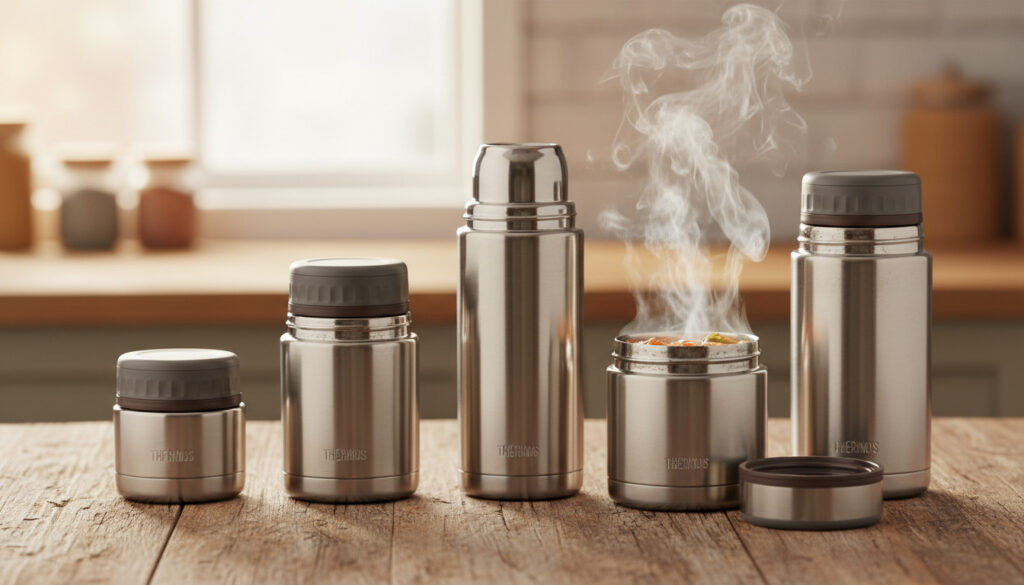
Thermos Food Jar – Heat Retention, Sizes and Best Models
Thermos food jars utilize vacuum insulation technology to maintain meal temperatures for extended periods without external heating sources. These double-wall stainless steel containers create an airless barrier between the food chamber and exterior environment, significantly slowing thermal transfer compared to foam-insulated alternatives.
Independent laboratory testing and manufacturer specifications indicate that premium models like the Stainless King 24oz maintain hot food temperatures for up to 14 hours and cold contents for 24 hours. Construction features vary by product line, with adult-oriented models emphasizing maximum retention capacity while children’s variants prioritize drop resistance and ergonomic handling.
Understanding actual performance metrics, safety limitations, and maintenance requirements helps determine whether these containers suit specific dietary needs and daily routines. This analysis examines verified heat retention data, comparative brand testing, and long-term durability assessments across the Thermos product range.
How Long Does a Thermos Food Jar Keep Food Hot?
| Specification | Details |
|---|---|
| Heat Retention | Up to 14 hours hot / 24 hours cold |
| Materials | Stainless steel vacuum-insulated |
| Sizes Available | 10oz to 24oz capacities |
| Key Feature | Leak-proof sealing mechanism |
- Laboratory testing demonstrates that the 16oz Stainless King retained approximately 169°F after five hours, outperforming budget alternatives by roughly 10°F.
- Pre-heating protocols significantly extend performance; conditioning the empty jar with boiling water for 5-10 minutes before adding food prevents initial heat loss to cold interior surfaces.
- Food consistency directly impacts duration, with liquid-based meals like soups maintaining temperatures longer than dense solids or pasta dishes.
- Fill volume affects retention efficiency, with maximum performance requiring the jar to reach capacity rather than partial filling.
- Ambient conditions modify results, as extreme cold weather may reduce stated retention times by several hours.
- Vacuum insulation technology eliminates air molecules between steel walls, creating thermal barriers superior to foam-based competitors.
- Real-world variables including lid-opening frequency and initial food temperature cause performance fluctuations of 2-4 hours from laboratory claims.
| Feature | Specification | Applicable Models |
|---|---|---|
| Max Hot Retention | 14 hours | Stainless King 24oz |
| Max Cold Retention | 24 hours | Stainless King 24oz |
| 5-Hour Test Result | ~169°F | Stainless King 16oz |
| Construction | Double-wall stainless steel | All models |
| Exterior Finish | Sweat-proof | Stainless King |
| Mouth Design | Wide mouth | All models |
| Dishwasher Safety | Top rack (hand wash preferred) | Stainless King |
| Capacity Range | 10oz–24oz | Funtainer to Stainless King |
| Leak Resistance | Leak-proof when closed | Stainless King |
| Lid Mechanism | Push-button or screw-top | Funtainer/Stainless King |
| Accessories | Folding spoon, serving bowl | Stainless King |
| Price Range | $20–$30+ | Funtainer to Stainless King |
According to manufacturer specifications, the Stainless King 24oz maintains these temperatures through vacuum insulation technology that creates an airless barrier between interior and exterior walls.
Are Thermos Food Jars Microwave Safe and Leak Proof?
Microwave Safety Limitations
Vacuum insulation technology renders these containers incompatible with microwave heating. Product documentation explicitly warns against microwaving, as the sealed vacuum environment and metal construction create safety hazards and potential appliance damage. Food requires pre-heating to serving temperature before transfer into the jar.
Leak-Proof Engineering and Real-World Performance
The Stainless King series incorporates a built-in insulated serving bowl with sealing mechanisms rated as leak-proof when properly closed. Product demonstrations indicate these seals withstand standard transport positioning, though active shaking or vertical inversion may compromise containment depending on food consistency.
Durability and Construction Standards
Drop-testing reveals significant durability variations between product tiers. The Funtainer 10oz survives repeated impacts typical of children’s daily use, though exterior coatings may chip over time. Stainless King models demonstrate superior structural integrity correlating with premium pricing and stainless steel gauge thickness.
Thermos Food Jar Sizes, Capacities and Best Models
Adult Capacity Options
The 24oz Stainless King serves as the flagship adult model, providing maximum heat retention ratings and an integrated serving bowl that functions as a secondary container. The 16oz Stainless King offers equivalent insulation performance in reduced dimensions suitable for single meals. The 12oz ThermoCafé variant targets lunchbox compatibility with moderate heat retention relative to its compact size.
Children’s Models and Ergonomic Features
The 10oz Funtainer incorporates child-specific design elements including push-button lid operation, cool-to-touch exterior surfaces, and integrated folding spoons. Specifications indicate a lightweight profile measuring 3.5 inches in diameter by 5.3 inches in height, with Tritan snack tops providing separate dry storage compartments. The 16oz Funtainer accommodates older children requiring larger portions while maintaining identical construction standards.
Performance Classification
Controlled thermal testing establishes clear hierarchies: the 16oz Stainless King outperforms the 12oz ThermoCafé by approximately 10°F in five-hour tests, attributing differences to insulation layer quality and vacuum seal integrity. Adult models prioritize thermal efficiency while children’s variants emphasize portability and impact resistance.
Thermos Food Jar vs Other Brands and Price Guide
Retail tracking indicates Funtainer series pricing typically ranges from $20 to $23, positioning these units as mid-market options between generic supermarket brands and premium competitors like YETI. Stainless King models command higher prices commensurate with 14-hour retention capabilities.
Comparative analysis reveals that while YETI Rambler containers provide comparable heat retention, they weigh significantly more than Thermos equivalents. This weight differential impacts portability for children and hikers prioritizing minimal carry loads.
Direct testing between Thermos and Zojirushi models remains undocumented in available research. While Stainless King performance exceeds generic brands, specific comparative data against Japanese-manufactured vacuum containers is not established.
Market positioning shows Thermos occupying the middle segment between disposable containers and premium outdoor brands. Buying guide analysis identifies the Funtainer as the best budget selection versus pricier alternatives, offering acceptable durability and heat retention for school lunch durations. Versus Stanley Classic series, Thermos provides lighter construction but potentially reduced impact resistance.
Long-term user testing of the Funtainer 10oz yielded a 3.5/5 rating, noting sturdy construction that survived drops but inconsistent performance with solid foods beyond soups and beverages. The review indicates difficulty filling and eating non-liquid contents from the narrow opening.
How Heat Retention Performs Throughout the Day
- Pre-heating phase (0 minutes): Pouring boiling water into the empty jar and sealing for 5-10 minutes conditions interior surfaces, preventing initial heat loss.
- Initial fill (0 hours): Adding food at 165°F–170°F immediately after pre-heating establishes maximum starting temperature.
- Mid-morning benchmark (5 hours): Laboratory measurements indicate Stainless King models maintain approximately 169°F, exceeding safe eating temperatures.
- Lunch service window (6-8 hours): Most users access contents during this period, with temperatures typically ranging 140°F–150°F depending on food volume and consistency.
- Extended holding (14 hours): Manufacturer claims suggest safe hot food temperatures persist through standard workdays and commutes for premium models.
- Cold retention (24 hours): The same vacuum insulation preventing heat entry maintains chilled contents for full-day durations, suitable for extended travel.
- Maintenance window (Within 24 hours): Cleaning recommendations specify washing before food residue sets, preventing stainless steel staining and odor retention.
Established Specifications vs. Real-World Variables
| Verified Facts | Uncertain or Variable Factors |
|---|---|
| Vacuum insulation provides 14-hour heat retention in Stainless King 24oz models | Actual retention varies 2-4 hours based on food consistency and ambient temperature |
| Stainless King is dishwasher safe on top rack per manufacturer | Long-term effects of repeated dishwasher cycles on vacuum seal integrity not quantified |
| Funtainer 10oz weighs less than competing YETI Rambler models | Direct weight comparisons with Zojirushi food jars unavailable in tested sources |
| Leak-proof sealing when properly closed on Stainless King | Performance during active shaking or vertical transport not standardized |
| Wide mouth design facilitates filling and cleaning | Long-term durability of folding spoons and push-button mechanisms varies by usage frequency |
| Retail pricing ranges $20–$23 for Funtainer models | 2025 specific pricing subject to retailer variation and regional availability |
| Maximum 169°F retention at 5 hours in controlled testing | Performance with partially filled containers not extensively documented |
The Technology Behind Portable Food Insulation
Vacuum insulation originated from cryogenic storage applications, adapting industrial thermal management for consumer food transport. Modern food jars represent the convergence of this technology with portable dining needs, replacing traditional lunch pails and single-wall containers that relied on external thermal mass.
The shift toward stainless steel construction addresses sustainability concerns while providing durability advantages over foam-insulated alternatives that degrade with repeated use. Products like the Monte Carlo Biscuit – History Ingredients and Facts illustrate historical approaches to portable food, whereas contemporary vacuum-sealed designs maintain thermal performance characteristics for years when properly maintained.
Unlike disposable packaging, these containers require initial investment costs offset by reusable lifespans. The technology proves particularly valuable for dietary management requiring specific serving temperatures, such as infant meals or specialized medical diets, though users must verify individual model capacities against specific portion requirements.
Expert Testing and User Feedback
“The 16oz Stainless King retained approximately 169 degrees Fahrenheit after five hours in controlled testing, outperforming cheaper 16oz models and the 12oz ThermoCafé by roughly 10 degrees due to superior insulation layers.”
Independent thermal analysis, 2024
“While sturdy and rugged enough to survive routine drops, the Funtainer proves inconsistent for solids beyond soups and beverages, requiring significant effort to fill and eat non-liquid contents.”
DadLikesGear product evaluation, January 2024
“Thermos Funtainer stands out as the best budget pick versus pricier alternatives like the YETI Rambler, offering excellent retention for school lunches despite lighter construction.”
CubbyAtHome comparative analysis
Selecting the Appropriate Thermos Model
Adults requiring maximum heat retention for long work shifts should prioritize the Stainless King 24oz, which delivers verified 14-hour performance and includes serving accessories. Parents seeking durable solutions for school lunches may select the Funtainer 10oz for younger children or the 16oz variant for adolescents, acknowledging limitations in solid-food usability compared to adult models. Pokemon Go Plus – Setup Guide, Battery Life and 2025 Review offers additional perspective on portable technology, though pre-heating remains the critical factor for achieving stated retention times regardless of selected model.
Common Questions About Thermos Food Jars
Can I pack pasta or solid foods in a Thermos food jar?
Yes, though performance varies. Testing indicates liquid-based foods like soups retain heat most effectively. Solid foods such as pasta work but may cool faster and prove difficult to eat from narrow openings, particularly in Funtainer series designed primarily for beverages.
Why does my Thermos food jar lose heat faster than expected?
Common causes include failing to pre-heat the jar with boiling water before filling, adding food at insufficient initial temperatures, or leaving significant air space at the top. Opening the lid multiple times before consumption also accelerates heat loss beyond laboratory conditions.
Are Thermos food jars safe for baby food?
While constructed from food-grade stainless steel, manufacturer specifications do not specifically address baby food storage. The containers maintain temperatures suitable for bacterial growth prevention for several hours, but parents should verify temperature safety before serving and avoid storing perishable infant foods for extended periods.
What is the difference between Stainless King and Funtainer series?
Stainless King targets adults with superior 14-hour heat retention, larger capacities, and integrated serving bowls. Funtainer models prioritize kid-friendly features including push-button lids, snack compartments, and rugged lightweight construction, with retention suitable for school lunch durations.
Can I put carbonated beverages in a Thermos food jar?
Manufacturer documentation does not recommend carbonated beverages. The sealed vacuum environment can create pressure buildup, potentially forcing liquid past seals when opened. Wide-mouth Stainless King models handle pressure better than push-button Funtainer designs, but both carry spill risks.
How do I prevent stains and odors?
Rinse immediately after use to prevent residue from setting. Avoid abrasive cleaners that scratch stainless steel interiors. Store jars open to air-dry completely, preventing moisture accumulation that leads to odors. Separate lid components during washing to eliminate trapped food particles.
More related posts
 Mark Dreyfus: Biography, Career, Family and Recent Absence
 Adam Reynolds: Career, Family & Retirement Plans
 Death and Funeral Notices in Ireland: Recent & Historical Guide
 Sea Moss Benefits: Health Claims, Risks and Evidence
 Mike Mentzer: Heavy Duty Training Method and Legacy
 Vietnamese Near Me – Best El Paso Pho and Banh Mi
 Scarlett Johansson: Children, Marriages, Career & Net Worth (2024)
 Peter Pan’s Real Story: Origins, Dark Themes, and More