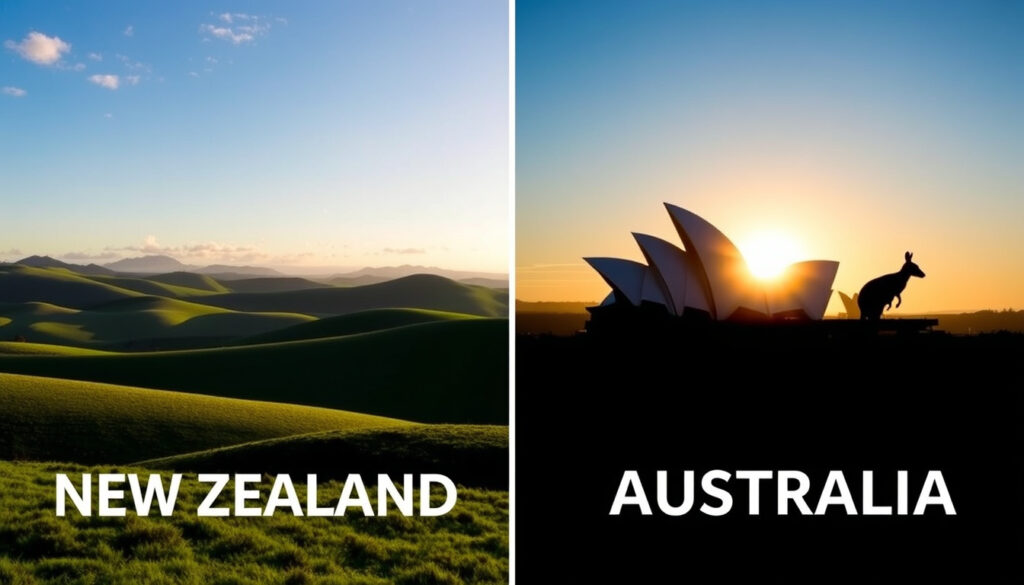
New Zealand vs Australia: Which Country Is Better to Live
You’ve probably heard the friendly rivalry between New Zealand and Australia. But choosing where to live means weighing real data, not just rugby scores. Australia draws newcomers with bigger paychecks and warmer weather, while New Zealand counters with lower living costs and cooler scenery. This comparison digs into the numbers that actually matter for expats, travellers, and anyone trying to decide between the two.
Population (Australia): 26 million ·
Population (New Zealand): 5 million ·
Area (Australia): 7.7 million sq km ·
Area (New Zealand): 268,000 sq km ·
Life expectancy (Australia): 83 years ·
Life expectancy (New Zealand): 82 years
Quick snapshot
- Australia is larger in area and population (Worldometers world population data)
- New Zealand has a cooler temperate climate (NIWA New Zealand climate authority)
- Both countries have universal healthcare (AIHW health system overview)
- Kangaroo is endemic to Australia (Department of Environment Australian government)
- Which country is ‘safer’ depends on specific metrics (crime types, natural disasters) (UNODC crime statistics)
- Cost of living varies significantly by city (livingcost.org cost comparison site)
- Subjective beauty preference between the two countries (UNODC crime statistics)
- Net migration from New Zealand to Australia continues as of 2025, driven by higher wages (Australian Bureau of Statistics migration data)
- New Zealand’s population grew 0.8% in 2024, Australia’s grew 2.3% (Stats NZ demographic data)
- Expat decision-making will hinge on job offers, family stage, and climate preference (International Citizens Insurance expat guide)
- Cost-of-living gap may narrow as Australian housing cools and NZ inflation eases (RBNZ economic outlook)
The data table below provides a grounding in basic facts before we get into the comparison dimensions.
| Aspect | Australia | New Zealand |
|---|---|---|
| Capital | Canberra | Wellington |
| Largest city | Sydney | Auckland |
| Official language | English | English, Māori, NZ Sign Language |
| Currency | Australian Dollar (AUD) | New Zealand Dollar (NZD) |
| Time zone | UTC+8 to UTC+11 | UTC+12 to UTC+13 |
| Driving side | Left | Left |
Which is better, Australia or New Zealand to live?
For most expats, the answer comes down to salary versus cost of living. According to livingcost.org cost comparison site, Australia is about 29% more expensive overall, but median after-tax salaries run around $4,122 per month compared to New Zealand’s $3,147. That means more buying power in Australia for those who land a job — but higher rent and food bills eat into it.
Higher Australian wages only stretch further if you avoid Sydney and Melbourne. In smaller Australian cities like Adelaide or Hobart, the cost advantage flips toward New Zealand’s mid-sized cities.
Is Australia a better place to move than New Zealand?
Data from Numbeo crowdsourced cost-of-living database shows that property prices per square foot in Australian city centres average 988.56 A$, versus 754.04 A$ in New Zealand. Outside city centres, the gap narrows to 724.32 A$ vs 527.84 A$. Rent follows: one-bedroom apartments in Australian cities run about 30% higher than in New Zealand, per the same source.
MyLifeElsewhere comparison platform reports that childcare, groceries, and restaurant prices are all higher in Australia — childcare alone costs A$500–700 per week in Australia versus NZ$250–300 in New Zealand, according to MoveHub relocation cost data.
Why are people moving out of New Zealand?
Net migration from New Zealand to Australia has been consistent for years. The Australian Bureau of Statistics population movement records shows that in the year ending June 2024, over 52,000 New Zealanders moved to Australia long-term. Higher salaries — especially in construction, healthcare, and tech — are the top pull factor, alongside Australia’s larger job market.
Why are New Zealanders moving to Australia?
Beyond wages, New Zealanders cite Australia’s warmer climate and more affordable consumer goods. Upmove expat relocation blog notes that utilities in New Zealand are about 34% cheaper, but groceries and electronics cost less in Australia due to scale. The trans-Tasman travel corridor makes moving easy — New Zealand citizens can live and work in Australia indefinitely under the Special Category Visa.
Which is safer, NZ or Australia?
Safety is a multi‑layer concept — crime rates, natural disaster risks, and health hazards all factor in. According to UNODC United Nations crime statistics, Australia’s intentional homicide rate is 0.83 per 100,000, while New Zealand’s is 0.95. Victimisation rates for theft and assault are slightly higher in New Zealand (18.6% vs Australia’s 16.9%). But these differences are small.
The OECD Better Life Index quality-of-life measurement reports that 75% of Australians feel safe walking alone at night, compared to 74% of New Zealanders — effectively a tie.
What is the silent killer in Australia?
Heart disease is the leading cause of death in Australia, accounting for about 17,800 deaths in 2022, per the Australian Institute of Health and Welfare health statistics authority. Extreme heat also poses a growing threat: The Lancet medical journal reported a 35% increase in heat-related mortality in Australia between 2010 and 2020. New Zealand, with its cooler climate, experiences fewer heat‑related health emergencies.
A family moving to Australia’s inland cities should budget for air conditioning and check local heat‑wave plans. In New Zealand, earthquake preparedness — not heat — is the main daily safety concern.
How is New Zealand different from Australia?
The two countries differ in geography, climate, and cultural rhythm. Australia spans a whole continent with desert interior; New Zealand is two main islands with alpine mountains and rainforests. Politically, both are constitutional monarchies with Westminster systems, but New Zealand has a unicameral parliament and no state‑level governments — making it less bureaucratic, many say.
The implication for expats: Australia offers more administrative complexity but also more policy variety across its states, while New Zealand provides simpler national-level rules.
Which is more beautiful, New Zealand or Australia?
Beauty is subjective, but data backs the stereotypes. New Zealand’s South Island alone has 600+ glaciers and 14 national parks (Department of Conservation NZ government). Australia counters with the Great Barrier Reef — the world’s largest coral reef system — and the red centre of Uluru. In a 2024 survey by Rough Guides travel authority, New Zealand ranked 1st for natural beauty, Australia 4th. But “beautiful” depends on whether you prefer fjords or flat red deserts.
Which country should you visit?
For a short holiday, New Zealand offers easier road trips with scenery packed into smaller distances. For a longer trip, Australia’s sheer size and variety — from rainforests to wine regions to surf beaches — provides more diversity. The Tourism Australia official tourism body recommends at least three weeks to see the east coast alone.
What does ‘yeah nah’ mean in NZ?
New Zealand slang “yeah nah” is a polite way of saying “no” — it acknowledges the question but disagrees. For example: “Would you like another beer?” — “Yeah nah, I’m driving.” It’s a linguistic quirk that softens refusal. The New Yorker cultural commentary called it “a masterclass in politeness.”
How do Kiwis say no?
“Yeah nah” is the most famous, but Kiwis also use “sweet as” for “fine” and “chur” for “thanks” or “cool.” The New Zealand accent is famously non‑rhotic (dropping “r” sounds) and uses short vowel shifts — “fish and chips” sounds like “fush and chups” to outsiders. Linguistics Society of NZ language research notes that these features are more pronounced in younger speakers.
Why do aussies say ‘oi, oi, oi’?
“Oi” in Australian English is a conversational attention‑getter, similar to “hey.” It became famous through the sports chant “Aussie, Aussie, Aussie, oi, oi, oi.” The word originates from British English but was amplified in Australian culture. According to ABC Education public broadcaster language feature, the chant became cemented at the 2000 Sydney Olympics.
Which animal is found only in Australia?
Australia is home to 21 of the 25 most venomous snake species (World Atlas geography and wildlife reference), but the most iconic endemic animal is the kangaroo. Others include the koala, platypus, and emu — all found nowhere else in the wild. New Zealand’s endemic species are equally remarkable but flightless: the kiwi bird, the tuatara (a living fossil reptile), and the giant weta.
Unique wildlife of New Zealand
New Zealand has no native land mammals (except two species of bats), so birds evolved to fill those roles. The kiwi — about the size of a chicken — cannot fly, has whiskers like a cat, and lays eggs almost 20% of its own body weight. Department of Conservation NZ biodiversity records estimates only 70,000 kiwi remain in the wild, making them a threatened species. The tuatara, which predates dinosaurs, lives on protected offshore islands.
Comparison: Australia vs New Zealand at a glance
Three key dimensions where the two countries diverge most sharply for expats and travellers.
| Dimension | Australia | New Zealand | Notes |
|---|---|---|---|
| Cost of living (monthly, single) | $2,425 | $1,877 | Australia 29% more expensive (livingcost.org) |
| Monthly after-tax salary (median) | $4,122 | $3,147 | Higher buying power in Australia (Numbeo) |
| Homicide rate (per 100,000) | 0.83 | 0.95 | Near identical (UNODC) |
| Feel safe walking alone at night | 75% | 74% | OECD Better Life (OECD) |
| Natural hazard risk | Bushfires, cyclones, heat | Earthquakes, volcanoes | Different profiles (USGS) |
| One-bedroom rent (city centre) | ~A$2,200/month | ~NZ$1,600/month | Australia ~30% higher (Numbeo) |
Upsides
- Higher salaries in Australia for most professions
- Lower cost of living in New Zealand (especially rent and utilities)
- Both offer universal healthcare and high life expectancy
- New Zealand’s natural scenery is more accessible for outdoor recreation
- Australia’s larger economy means more job variety and career growth
Downsides
- Australia’s housing costs are significantly higher in major cities
- New Zealand salaries lag behind, especially for experienced professionals
- Extreme heat and bushfire risk in parts of Australia
- New Zealand’s smaller job market can limit career mobility
- Both countries face high immigration demand, tightening rental markets
For the mobile remote worker earning global rates, New Zealand offers a better quality‑of‑life per dollar. For the in‑person employee chasing peak earnings, Australia remains the stronger bet. The gap closes if you value community size and climate ties over raw income.
Clarity check
Confirmed facts
- Australia is larger in area and population.
- New Zealand has a cooler temperate climate.
- Both countries have universal healthcare.
- Kangaroo is endemic to Australia.
- Kiwi bird is endemic to New Zealand.
What’s unclear
- Which country is “safer” depends on specific metrics (crime types, natural disasters).
- Cost of living varies significantly by city — not country‑averages.
- Subjective beauty preference between the two countries.
Perspectives from the ground
“Aus has lower GST, zero first tax bracket, lower food prices. But rent in Auckland is comparable to Brisbane now.”
— Reddit user in r/newzealand, discussing cost-of-living differences (Reddit discussion thread)
“Both countries share a British colonial heritage and close political ties, including the Trans‑Tasman Travel Arrangement.”
— Wikipedia article on Australia–New Zealand relations (Wikipedia historical and diplomatic overview)
The Reddit view captures a practical reality: taxes and food costs are lower in Australia, but Auckland rents are creeping up to Australian levels. The Wikipedia line reminds us that migration between the two is far easier than moving to any other country — a key advantage for expats unsure which side to choose.
Summary
The Australia–New Zealand choice isn’t about one country being “better” — it’s about which set of trade‑offs fits your life stage. Australia rewards ambition with higher wages, bigger cities, and reliable warmth. New Zealand rewards patience with lower living costs, easy access to nature, and a slower rhythm. For the Australian‑based worker weighing a move across the ditch, stay if you are chasing a promotion; explore if you are chasing peace.
Related reading: Australia v South Africa: Rugby & Cricket Guide 2025 · Cotton On Australia: Brand, Stores & Online Shopping Guide
For a more detailed cost of living comparison, see this detailed cost of living comparison that breaks down housing, groceries, and utilities across major cities.
Frequently asked questions
What is the cost of living difference between Australia and New Zealand?
Australia is about 29% more expensive overall, with higher rent, food, and transport costs. New Zealand offers cheaper utilities and childcare. (livingcost.org)
Which country has better beaches?
Australia has more famous beaches (Bondi, Whitehaven, Surfer’s Paradise) but New Zealand’s wild west coast beaches are less crowded. Both have world‑class coastlines.
Is healthcare free in both countries?
Both have universal public healthcare. Australia’s Medicare covers residents and citizens; New Zealand’s public health system covers everyone with permanent residency. Minor costs for GP visits apply in both.
What is the weather like in each country?
Australia ranges from tropical north to temperate south, with arid desert covering much of the interior. New Zealand is temperate year‑round, with ocean‑influenced mild to cool climate and high rainfall in the west.
Which country is more multicultural?
Australia has a larger immigrant population (over 30% born overseas) and more visible diversity, especially in Sydney and Melbourne. New Zealand’s diversity includes a significant Māori and Pacific Islander population.
Are there any visa differences for expats?
New Zealand citizens can live and work indefinitely in Australia under the Special Category Visa. Australians can apply for a similar arrangement in New Zealand. Other nationalities need to go through standard skilled migration for each country.
Which country offers better work-life balance?
New Zealand generally scores higher on work‑life balance, with shorter average working hours and stronger emphasis on leisure. Australia has higher earnings but longer hours in professional sectors.
More related posts
 Lord Byron: Biography, Works, Exile, and Scandalous Life
 Office 365 Download – Step-by-Step Installation Guide
 Jaswinder Bhalla Death 2025: Cause, Age, Son, Last Movie
 Iman Shumpert: NBA Career, Divorce, and Net Worth
 Ian Holm: Biography, Death, and Iconic Roles
 Pak v AFG 2026: Cricket, Military & Diplomacy Compared
 Lorraine Bracco: Biography, Career, and Relationships
 Zoey Deutch: Biography, Career, and Nepo Baby Debate