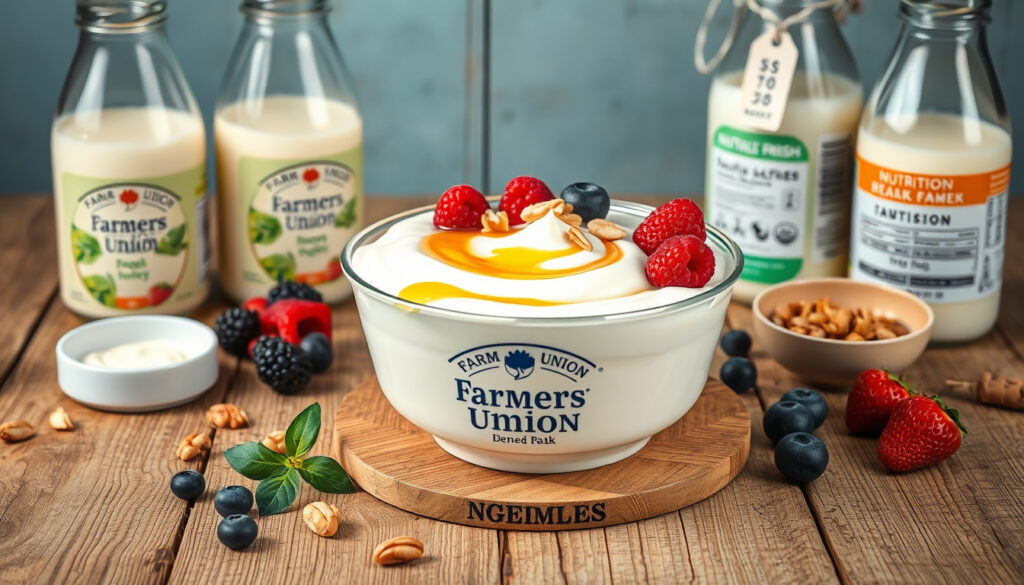
Farmers Union Greek Yoghurt – Nutrition, Ingredients & Prices
Farmers Union Greek Style Yoghurt is an Australian-made dairy product produced by a farmer-owned cooperative. Available in natural, high-protein, and flavoured varieties, it has carved out a significant position in the Australian yoghurt market as an affordable alternative to imported Greek-style brands. The product is widely stocked at major supermarket chains and positions itself on quality Australian ingredients, high protein content, and a thick, strained texture that appeals to health-conscious consumers and fitness users alike.
This guide compiles verified nutrition data, ingredient details, pricing context, and brand background to help consumers make informed decisions about whether Farmers Union Greek Style Yoghurt suits their dietary needs and preferences.
Product Overview and Brand Background
Farmers Union is owned by an Australian dairy cooperative and operates within South Australia, producing Greek-style yoghurt from locally sourced milk. The brand has grown from a traditional cooperative model into a nationally recognised product line, competing directly with brands such as Chobani and Jalna. Its marketing emphasises Australian ownership and production, which resonates with consumers seeking locally made dairy options. The cooperative structure means the business is ultimately driven by farmer members rather than external investors, potentially influencing decisions around ingredient sourcing and product quality.
The product range spans plain natural varieties, high-protein formulations targeting fitness and muscle-recovery consumers, and flavoured options such as vanilla. Each variant maintains a strained, thick consistency achieved through a traditional Greek-style production method. The brand describes its plain varieties as having a “deliciously simple” taste derived from quality Australian milk, appealing to consumers who prefer minimal processing and straightforward ingredient lists.
Farmers Union is distinct from imported Greek-style yoghurts because it is produced entirely within Australia using predominantly Australian-sourced ingredients, making it a consistent choice for consumers prioritising locally made dairy products.
Key Product Details at a Glance
| Attribute | Detail |
|---|---|
| Origin | South Australia, Australian dairy co-op |
| Key Feature | Strained Greek-style texture, high protein options |
| Variants Available | Plain natural, high-protein, vanilla |
| Stockists | Coles, Woolworths |
Core Insights
- Produced by a farmer-owned cooperative, ensuring alignment with local dairy interests
- Offers up to 16 grams of protein per serve in high-protein variants
- Plain and high-protein lines contain no added sugar
- Uses live cultures including Streptococcus Thermophilus and Lactobacillus Bulgaricus
- Suitable for low-carbohydrate, keto, and high-protein diet approaches
- Competitively priced against Chobani and Jalna across most supermarket outlets
Nutrition Facts and Ingredients Breakdown
Nutritional profiles vary across the Farmers Union product range, with each variant designed to serve different dietary requirements. The plain natural varieties deliver higher fat content for those seeking sustained energy, while the high-protein range targets consumers focused on muscle recovery and lean eating. Below is a detailed breakdown of available variants based on verified retailer and product data.
Greek Style Natural (Standard)
The standard natural variant provides approximately 127 calories per 100 grams, with 4.8 grams of protein and 9.7 grams of fat, of which 6.5 grams is saturated. Carbohydrate content sits at 5.2 grams per 100 grams, consisting entirely of naturally occurring sugars with no added sugar. Sodium levels are modest at 57 milligrams per 100 grams. Calcium content reaches 162 milligrams per 100 grams, representing roughly 20% of the recommended daily intake for adults. The macronutrient breakdown leans heavily toward fat at approximately 70% of calories, with protein comprising around 14% and carbohydrates 16%.
High Protein Variant
The high-protein formulation is specifically engineered for fitness-oriented consumers, delivering 16.6 grams of protein per 200-gram serve, which translates to approximately 8.3 grams per 100 grams. Calorie content drops to 116 per 100 grams (232 kilojoules), with fat reduced to under 0.5 grams per 100 grams. Natural sugars remain low at 4.9 grams per 100 grams, and no added sugar is present. Sodium increases marginally to 59 milligrams per 100 grams. This variant holds a 5 Health Star Rating and is both gelatin-free and gluten-free, making it accessible to consumers with specific dietary restrictions. The formulation uses milk solids and skim milk combined with live yoghurt cultures.
Vanilla Flavour
The vanilla variant differs most notably in its sugar content, which rises to 9.9 grams per 100 grams, including approximately 7 grams of added sugar per serving. Protein content decreases slightly to 3.7 grams per 100 grams, while fat sits at 8.4 grams with 5.5 grams of saturated fat. Calcium content is comparable at 144 milligrams per 100 grams, representing 18% of recommended daily intake. The vanilla variety remains free from artificial colours, flavours, and preservatives, and maintains gluten-free status. It contains the same live culture base as other variants.
Both the standard natural and vanilla varieties provide approximately 20% of the adult recommended daily intake of calcium per 100-gram serving, supporting bone health as part of a balanced diet.
Complete Nutrition Comparison
| Variant | Calories (per 100g) | Protein | Fat | Sat Fat | Carbs | Sugars | Sodium | Calcium |
|---|---|---|---|---|---|---|---|---|
| Greek Style Natural | 127 kcal (529 kJ) | 4.8g | 9.7g | 6.5g | 5.2g | 5.2g | 57mg | 162mg (20% RDI) |
| High Protein | 116 kcal (232 kJ) | 8.3g | 0.2g | <0.5g | 4.9g | 4.9g | 59mg | — |
| Vanilla | ~108 kcal | 3.7g | 8.4g | 5.5g | 10.3g | 9.9g | 52mg | 144mg (18% RDI) |
Ingredient Composition and Dietary Suitability
The ingredient lists for Farmers Union products are notably short, particularly for the plain natural and high-protein variants. The Greek Style Natural and High Protein formulations consist primarily of milk, milk solids, cream, and live yoghurt cultures. No artificial additives, preservatives, or thickeners are included in these lines, which aligns with consumer preferences for minimally processed dairy products.
The live cultures used include Streptococcus Thermophilus and Lactobacillus Bulgaricus, standard bacterial strains in traditional yoghurt production. Some product lines are fortified with up to 30 billion probiotics, and certain variants include prebiotic fibre to support gut health. The vanilla variant adds vanilla bean and naturally derived sugar to its ingredient list but maintains the absence of artificial colours, flavours, and preservatives that characterise the broader range.
All Farmers Union Greek Style Yoghurt products are manufactured in Australia using at least 99% Australian ingredients. The plain and high-protein lines carry no added sugar, which positions them favourably against flavoured competitors and aligns with dietary approaches that emphasise reduced sugar intake.
The high-protein variant is gelatin-free and gluten-free, making it suitable for consumers following gluten-restricted diets. The plain natural varieties support low-carbohydrate and keto eating patterns due to their low net carb content.
Who Should Consider Farmers Union Greek Style Yoghurt
The plain and high-protein variants appeal most to consumers focused on protein intake, weight management, and clean eating. Fitness enthusiasts and those engaged in regular exercise may benefit from the high-protein formulation’s 16 grams per serve, supporting muscle recovery without excessive calories. Individuals following low-carbohydrate or keto diets will find the natural variety compatible with their nutritional targets. Consumers prioritising gut health may be drawn to the probiotic content across all variants and the additional prebiotic fibre found in specific lines.
Where to Buy and Pricing Context
Farmers Union Greek Style Yoghurt is stocked by the two largest Australian supermarket chains, Woolworths and Coles. The high-protein 500-gram variant is regularly available at Woolworths, while smaller 500-gram and larger 1-kilogram options provide flexibility for different household needs. Smaller 500-gram containers work well for individual consumption or small households, whereas 1-kilogram formats suit families or consumers who use yoghurt regularly in cooking, smoothies, or meal prep.
Pricing positions Farmers Union competitively against comparable products. The 500-gram high-protein format typically retails in the range of AUD 5 to 7, while Chobani equivalents sit in the AUD 6 to 8 range and Jalna products around AUD 5 to 6. Exact prices fluctuate based on promotions, location, and retailer, so consumers are encouraged to check current pricing through supermarket apps or in-store displays. The brand’s value proposition rests on delivering comparable protein content and quality to premium alternatives at a lower price point.
The brand positions itself as “Australia’s most loved plain Greek Style Yogurt,” which reflects an ambition to lead in the natural, unflavoured segment rather than the flavoured or novelty space. This positioning aligns with a consumer trend toward reduced sugar and fewer additives, where plain yoghurt formats tend to outperform flavoured variants on health perceptions. Farmers Union competes most directly with Jalna in the natural segment, as both are Australian dairy cooperatives, while Chobani represents a multinational brand with Australian manufacturing but US origins.
Taste, Texture and Consumer Impressions
Consumer-facing descriptions consistently reference a thick, creamy texture as the product’s standout characteristic, achieved through the straining process that removes whey and concentrates the yoghurt. This texture makes the product versatile for eating plain, using as a base for smoothies, incorporating into recipes, or serving as a substitute for higher-fat ingredients in cooking and baking.
The brand highlights the “deliciously simple” taste of its plain varieties, suggesting a flavour profile that lets the natural dairy quality come through without masking agents or flavour enhancements. For consumers accustomed to standard supermarket yoghurts, the Greek-style texture may present a notable difference, as the density is significantly higher than conventional unstrained formats.
The high-protein variant receives specific praise from fitness-oriented consumers for delivering substantial protein (16 grams per serve) with minimal fat, supporting recovery nutrition without excess calories. The natural variety attracts consumers interested in gut health due to its probiotic content and the inclusion of prebiotic fibre in some formulations. The vanilla option, while containing added sugar, maintains the same clean-ingredient philosophy of the broader range by avoiding artificial additives.
Farmers Union holds a distinct market position as an Australian cooperative brand competing on quality ingredients and competitive pricing. Independent taste tests and verified consumer review data were not available in the sources reviewed, so impressions are based on brand communications and retailer descriptions rather than aggregated independent ratings.
Brand History and Timeline
Farmers Union originated as a farmer cooperative based in South Australia, reflecting a business model where dairy farmers collectively own and govern the brand. This cooperative structure has shaped product decisions over time, prioritising ingredient quality and local sourcing over rapid expansion or diversification.
- Farmers Union cooperative established as a South Australian dairy collective, laying the groundwork for a farmer-owned brand focused on quality Australian dairy production.
- Expansion into Greek-style yoghurt formats during the 2010s, aligning with growing Australian consumer demand for strained, high-protein yoghurt products.
- Introduction of the high-protein product line, delivering 16 grams of protein per serve and targeting fitness and muscle-recovery segments of the market.
- Probiotic enhancement across selected variants, with some lines fortified with up to 30 billion live cultures and added prebiotic fibre for gut health support.
- Launch of muscle and bone health-focused product variants, incorporating calcium and protein benefits into targeted marketing.
- Introduction of vanilla flavour, expanding the range beyond plain offerings while maintaining the clean-ingredient philosophy.
- Continued active promotion and nutrition updates through 2026, maintaining relevance in a competitive yoghurt market against Chobani and Jalna.
Established Facts and Areas of Uncertainty
The following table clarifies what is confirmed through verified sources versus what remains uncertain or subject to change.
| Aspect | Established | Uncertain or Variable |
|---|---|---|
| Australian origin | Produced in South Australia by a farmer-owned cooperative | Specific factory location not detailed in public sources |
| Milk source | Australian dairy farmers; ≥99% Australian ingredients | Specific regional sourcing within Australia |
| Protein content | High-protein variant: 16g per serve; Natural: 4.8g per 100g | Batch-to-batch variation within labelled ranges |
| Probiotic strains | S. Thermophilus and L. Bulgaricus confirmed; 30 billion in select lines | Consistency of probiotic counts over shelf life |
| Pricing | Competitive range against Chobani and Jalna; AUD 5–7 for 500g high-protein | Real-time pricing at individual stores |
| Consumer reviews | Brand describes thick, creamy texture and quality taste | No aggregated independent review scores available |
How Farmers Union Compares to Rival Brands
The Australian Greek-style yoghurt market features several established competitors, with Chobani and Jalna representing the most direct comparisons to Farmers Union. Chobani, while US-founded, manufactures within Australia and positions itself as a premium flavoured yoghurt brand with extensive variant options. Jalna, like Farmers Union, operates as an Australian dairy cooperative, making the two more comparable in terms of business structure and local dairy commitment.
Farmers Union’s primary competitive advantage lies in its plain natural variants, where it targets the “most loved” position in the unflavoured Greek-style segment. The high-protein line competes directly with Chobani’s equivalent formulations, offering similar protein content (16 grams per serve) but with a lower fat profile and no added sugar in the plain version. Jalna competes most closely in the natural space, though its pricing and distribution overlap with Farmers Union across major supermarkets.
For consumers comparing options, the key differentiators include protein content (highest in Farmers Union’s high-protein variant), added sugar levels (lowest in plain and high-protein lines), price point (Farmers Union sits in the mid-range), and ingredient simplicity (all variants maintain short, recognisable ingredient lists). Monte Carlo Biscuit enthusiasts exploring Australian-made products may find similar satisfaction in the locally produced quality of Farmers Union.
Sources and References
Information in this guide draws from retailer product listings, distributor datasheets, and brand communications. Key sources include Woolworths product specifications for the high-protein variant, SuperiorFS distribution documentation for the 1-kilogram natural format, Calorie King nutritional databases, and official Farmers Union brand materials.
Farmers Union positions its Greek-style yoghurt as Australia’s most loved plain Greek-style option, emphasising simple ingredients, Australian milk, and a thick, strained texture suitable for everyday consumption and specialised dietary approaches.
Nutritional data confirms the high-protein variant delivers 16 grams of protein per serve with no added sugar and a 5 Health Star Rating, supporting its positioning within the health and fitness consumer segment.
Final Assessment
Farmers Union Greek Style Yoghurt represents a credible, Australian-made option for consumers seeking high-protein, minimally processed dairy. Its cooperative ownership model, competitive pricing, and clean ingredient profiles distinguish it in a crowded market. The high-protein variant is particularly well-suited to fitness-oriented consumers, while the plain natural options support low-carb and gut-health focused diets. Flavour enthusiasts may prefer the vanilla variant but should account for its higher sugar content relative to plain lines.
Compared to multinational competitors, Farmers Union holds its ground on price, protein delivery, and Australian origin. The main gaps in public information concern independent taste tests, detailed historical milestones, and expert health endorsements, which consumers should consider when weighing brand claims against verified data. Best Collagen Supplement consumers interested in holistic nutrition approaches may also explore how high-protein yoghurt fits within broader dietary strategies. Checking current stock and pricing through supermarket apps remains the most reliable method for confirming availability in a specific location.
Frequently Asked Questions
What are the main ingredients in Farmers Union Greek Style Yoghurt?
The plain natural and high-protein variants contain milk, milk solids, cream, and live yoghurt cultures (Streptococcus Thermophilus and Lactobacillus Bulgaricus). The vanilla variety adds vanilla bean and sugar but no artificial colours, flavours, or preservatives. All variants are gluten-free and use at least 99% Australian ingredients.
How much protein does the high-protein variant contain?
The high-protein formulation delivers 16.6 grams of protein per 200-gram serve, which equals approximately 8.3 grams per 100 grams. It carries a 5 Health Star Rating and contains no added sugar.
Where can I buy Farmers Union Greek Style Yoghurt?
It is available at major Australian supermarket chains, including Woolworths and Coles, in sizes ranging from 500 grams to 1 kilogram depending on the variant and retailer.
Is Farmers Union Greek Style Yoghurt suitable for people with gluten intolerance?
Yes. All variants are confirmed as gluten-free, making them suitable for consumers with coeliac disease or gluten sensitivity, provided no cross-contamination occurs during handling at home.
How does Farmers Union compare to Chobani in terms of protein content?
The high-protein Farmers Union variant delivers comparable protein levels to equivalent Chobani products, with both offering around 16 grams per serve. Farmers Union’s plain variants have the added advantage of containing no added sugar, whereas flavoured Chobani options typically include added sweeteners.
Does Farmers Union contain probiotics?
Yes. The base cultures in all variants include Streptococcus Thermophilus and Lactobacillus Bulgaricus. Some product lines are further fortified with up to 30 billion live cultures and prebiotic fibre to support gut health.
What is the price range for Farmers Union Greek Style Yoghurt?
The 500-gram high-protein format typically retails between AUD 5 and 7. Prices fluctuate by retailer and location. Comparable products such as Chobani (AUD 6–8) and Jalna (AUD 5–6) sit in a similar range.
Is Farmers Union yoghurt made from Australian milk?
Yes. The brand is Australian-owned and manufactured, using at least 99% Australian ingredients sourced from dairy farmers within the country.
More related posts
 Keke Palmer: Abuse Allegations and Custody Battle Explained
 Benson Boone: Biography, Facts, and Career
 911 TV Series – Cast, Seasons, Where to Watch
 Early Voting Sydney: Locations, Dates & How to Vote
 Natasha Richardson: Accident, Marriage, and Helmet Debate
 Tate McRae: Age, Net Worth, Real Name, Top Questions
 Nikolaj Coster-Waldau: Languages, Net Worth, Facts
 LeAnn Rimes’ Psoriasis, Marriage & Net Worth Explained