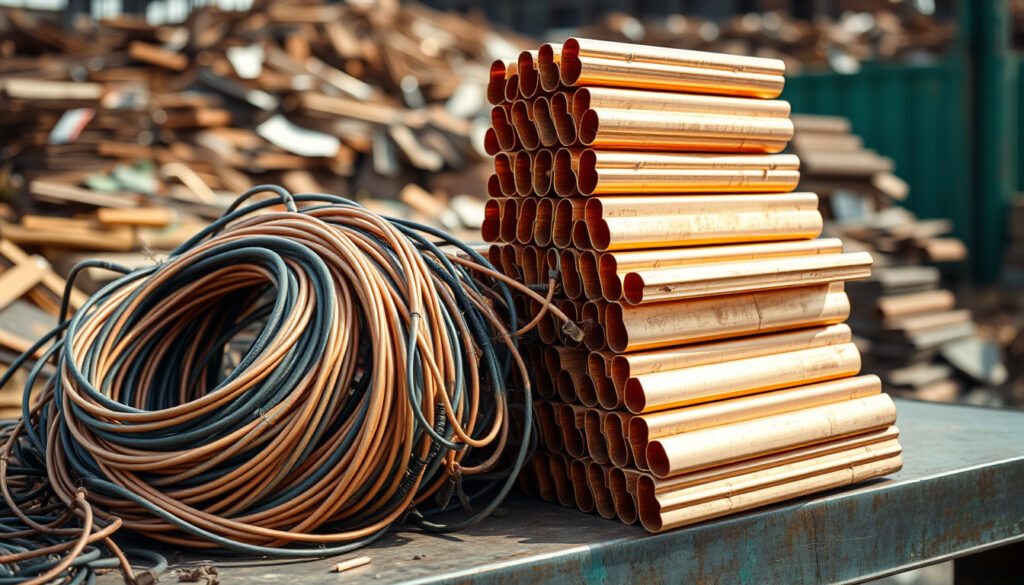
Copper Price Per kg Today: Ireland Scrap & Global Rates
If you’ve got old copper pipes in Dublin or Cork, understanding the difference between clean and dirty copper can earn you an extra euro per kilogram. As of June 2026, global copper is $13.73/kg, but Irish scrap yards pay about €6.90/kg.
Current copper price (global): $13.73 per kg (June 2026) ·
Scrap copper price in Ireland: €6.90 per kg ·
Copper price change (last year): +30.14% ·
All-time high (approx.): $10,730 per metric ton (Feb 2025)
Quick snapshot
- Global price: $13.73/kg (Markets Insider (financial data platform))
- Irish scrap: €6.90/kg (Scrapyard.ie (Irish scrap listing site))
- Up 30.14% over past year (Markets Insider)
- All-time high: $10,730/tonne (Feb 2025) (Markets Insider)
- Exact 2030 price remains speculation; forecasts range $12–$15/kg
- Whether the June 5 drop signals a longer correction or a short-term dip
- Copper’s 30.14% gain – precise timing vs. local yard rates may vary
- Clean vs dirty premium (~€1.10/kg) is an estimate, not a fixed yard quote
- Feb 2025: All-time high $10,730/tonne (Markets Insider)
- June 5, 2026: Sharp drop 3.8% to 6.26 USD/lb (TradingEconomics (commodity data provider))
- May 2026: Irish scrap at €6.90/kg (Scrapyard.ie)
- Electrification and green energy driving demand — analysts predict prices above $15,000/tonne by 2030
- Short-term volatility expected; watch US dollar strength and Chinese demand
Here is a quick-reference table of the most important copper pricing numbers.
| Label | Value |
|---|---|
| Current global price (USD/kg) | $13.73 |
| Current scrap price (EUR/kg, Ireland) | €6.90 |
| Year-over-year change | +30.14% |
| All-time high (USD/kg) | $10.73 |
| Price of clean vs dirty copper differential | ~€1.10/kg |
| UK clean wire (per tonne) | £5,600 (Reclamet (UK scrap recycler)) |
| Netherlands copper scrap (per kg) | €8.80 (Krommenhoek Metals (Dutch scrap yard)) |
| US #1 Bare Bright Wire (per lb) | $4.54 (iScrap App (US scrap price tracker)) |
| Copper scrap index (Europe) | €7,891/mt (Metaloop (scrap metal index)) |
How much is 1 kg of copper today?
Global benchmark price per kg
The most widely quoted copper price is the London Metal Exchange (LME) cash settlement. As of late June 2026, that works out to about $13.73 per kilogram, according to Markets Insider (financial data platform). TradingEconomics shows copper at 6.26 USD/lb, which equates to roughly $13.80/kg — a close match.
Copper price in USD and EUR
Converting the global price into euros (at ~1.08 USD/EUR) gives roughly €12.71/kg for pure refined copper. But that’s the exchange-traded price — scrap yards pay less because they need to cover processing and margin. For example, Krommenhoek Metals (Dutch scrap yard) lists copper scrap at €8.80/kg, while Scrapyard.ie reports €6.90/kg in Ireland.
The €5.81 difference between the LME price and Irish scrap rates isn’t a scam — it reflects transport, sorting, and smelting costs. Sellers who clean and strip their copper can narrow that gap by up to 30%.
How much is 1kg of copper worth in Ireland?
Scrap copper prices from Irish yards
Irish scrap yards update their prices regularly. According to Scrapyard.ie (Irish scrap listing platform), the standard mixed copper scrap rate in May 2026 was €6.90 per kilogram. That’s the price for general copper wire and pipe that may contain some insulation or solder.
Price differences by county (Dublin, Cork, Limerick)
Prices vary slightly across the country. Scrapyard.ie shows Dublin yards offering €6.90/kg, while Cork and Limerick sites such as Limerick Metal Recycling (local scrap yard) offer competitive rates within a few cents. The differences are small — usually under €0.20/kg — but can add up for large loads.
Selling in bulk (over 100 kg) often earns a premium of €0.50–€1.00/kg. Yards prefer volume because it reduces their per-unit handling costs.
Is copper going to skyrocket?
Market analyst forecasts for 2030
Copper demand is rising sharply due to electrification and green energy. IMARC Group (commodity research firm) reported Q1 2026 scrap prices of USD 9,118/MT in Germany and USD 9,038/MT in France. Multiple analysts predict prices above $15,000 per tonne by 2030, as supply struggles to keep up with electric vehicle and renewable infrastructure demand.
Factors driving potential price surge
The current price is already up 30.14% over the past year. According to MercatoMetalli (Italian commodity analysis site), copper moved from approximately €9,000 per tonne to beyond €11,500 per tonne between October 2025 and February 2026. That trend, combined with mine production constraints, supports bullish long-term forecasts.
What does ‘dirty copper’ mean?
Definition of dirty copper
In scrap trading, dirty copper refers to copper that is contaminated with other materials — insulation, solder, paint, or other metals. It requires additional processing to purify, so yards pay less for it.
Difference between clean and dirty copper grades
Clean copper — also called #1 bare bright wire — is bare, uncoated, and free of attachments. According to ScrapMetalBuyers (US scrap price guide), #1 Bare Bright Wire fetched $4.20/lb in 2026, while #1 Copper Tubing (slightly less clean) was $3.85/lb. At Irish yards, the differential between clean and dirty copper is roughly €1.10/kg — so cleaning your scrap can boost your payout by about 15–20%.
“Clean copper wire is the gold standard for scrap sellers. If you take the time to strip it, you can expect £5,600 per tonne in the UK — versus £4,300 for braziery copper.”
Why is copper falling?
Recent price decline in June 2026
On June 5, 2026, copper dropped 3.80% in a single trading session to 6.26 USD/lb, according to TradingEconomics (commodity data provider). That move erased some of the gains from earlier in the quarter.
Macroeconomic factors affecting copper
Traders cited a stronger US dollar and slowing industrial demand from China as reasons for the selloff. However, one-day drops of 3–5% are not unusual in commodity markets. Fastmarkets (commodity price agency) notes that copper scrap prices remain supported by tight supply, and the long-term trend remains upward.
What is the highest price copper has ever been?
All-time high in nominal terms
Copper reached an all-time nominal high of $10,730 per metric ton in February 2025, according to Markets Insider. That translates to about $10.73 per kilogram — still below today’s LME price of $13.73/kg, because the all-time high refers to a lower base period before the recent surge.
Record price per kg
In per-kilogram terms, the highest copper has ever been (in nominal USD) is $10.73/kg. However, adjusting for inflation, the 2020 peak of around $10,000/tonne in 2020 dollars would be higher in today’s money. The current price of $13.73/kg already exceeds that nominal record — copper has been setting new highs.
“Copper’s price trajectory has been extraordinary over the past 18 months, driven by electrification demand that shows no signs of slowing. The current level of $13.73/kg reflects both supply constraints and structural demand shifts.”
TradingEconomics commodity analyst
Timeline: Key copper price events
- Feb 2025: Copper reaches all-time nominal high of $10,730/tonne (Markets Insider)
- Oct 2025 – Feb 2026: Prices surge from €9,000 to €11,500/tonne (MercatoMetalli)
- May 2026: Scrap yard prices in Ireland hit €6.90/kg (Scrapyard.ie)
- June 5, 2026: One-day drop of 3.8% to 6.26 USD/lb (TradingEconomics)
What we know and what we don’t
Confirmed facts
- Current copper price as of June 2026 is $13.73/kg (Markets Insider)
- Scrap copper price in Ireland is €6.90/kg (Scrapyard.ie)
- All-time nominal high was $10,730/tonne in Feb 2025 (Markets Insider)
What’s unclear
- Exact 2030 copper price remains speculation; forecasts range $12–$15/kg
- Whether the June 5 drop signals a longer correction or a short-term dip
- The speed at which copper supply can respond to rising demand
- Whether the 30.14% gain over the past year will be sustained
- The exact premium for clean vs dirty copper varies by yard location
“Dirty copper is often misunderstood. In the scrap community, ‘dirty’ just means it needs processing — it’s still copper, just not ready for the furnace. The key is knowing what grade you have.”
Why this matters: For Irish scrap sellers, the gap between clean and dirty copper is a real opportunity. A few minutes of stripping can earn an extra €1 per kg. On a 50 kg load, that’s €50 — worth the effort.
| Location | Price (USD/MT) | Source |
|---|---|---|
| Germany | $9,118 | IMARC Group |
| France | $9,038 | IMARC Group |
| USA | $6,946 | IMARC Group |
Three countries, clear pattern: European scrap prices significantly higher than US, reflecting tighter supply and stronger industrial demand in the EU. Ireland’s price of ~€7,600/MT (€6.90/kg) sits between the US and continental rates.
For those looking to sell old wiring or pipes, checking the current copper scrap prices in Ireland can provide a useful benchmark against the global rates discussed here.
Frequently asked questions
How is copper priced per kilogram?
Copper is primarily traded on the London Metal Exchange (LME) as a futures contract priced per metric ton. To get the per-kilogram price, divide the tonne price by 1,000. Scrap yards then apply discounts for grade and processing costs.
What is the difference between copper futures and spot price?
The spot price is the current market price for immediate delivery. Futures are contracts for delivery at a future date and reflect expectations. Scrap yards typically base their prices on the LME spot price minus a margin.
Can I sell scrap copper to a yard without a license?
In Ireland, most scrap yards accept copper from individuals without a license, though you may need to show ID and provide your PPS number for cash payments over certain limits. Check with your local yard first.
Why do scrap copper prices vary by location?
Transport costs, local competition, and yard capacity all affect pricing. Urban areas with multiple yards (Dublin, Cork) tend to have slightly higher prices due to competition.
What is the best time to sell copper scrap?
Historically, copper prices tend to strengthen in Q2 and Q3 when construction and industrial activity peak. Avoid selling right after sharp one-day drops — wait a few days for recovery.
How does copper purity affect its price?
Purity is the main driver of scrap value. #1 clean copper (99.9% pure) commands the highest price. Dirty copper with insulation or solder can lose 15–30% of value. Always strip if you can.
Is copper recycling profitable for individuals?
Yes, especially if you accumulate a large quantity (50+ kg) and sell clean copper. At €6.90/kg, a 100 kg load nets €690 — well worth the trip to a yard.
Related reading: For unit conversion help with copper weights, see our mm to Inch Conversion Guide. For financial planning around scrap income, check the Take Home Pay Calculator for Ireland: 2026 Tax Guide.
Copper is in the middle of a structural bull run driven by electrification and green energy. For the Irish scrap seller, the choice is clear: clean your copper, watch the market for dips, and sell in volume. Irish scrap sellers who take these steps can expect to maximize their returns in a rising market.
More related posts
 Cheap Flights to Sydney – Lowest Fares and Booking Tips
 KKR vs Royal Challengers Bengaluru Match Scorecard: IPL 2025
 Standing Desks Ireland: Compare Local & Online Options
 Cairns Colonial Club Resort: Location, Rooms & Reviews
 Iran Supreme Leader: Mojtaba Khamenei, Power, Ayatollah
 105 Series LandCruiser: Guide, Specs, vs 100 Series
 Swiss Cheese Plant Care Guide: How to Grow Monstera Deliciosa
 Jaswinder Bhalla Death 2025: Cause, Age, Son, Last Movie