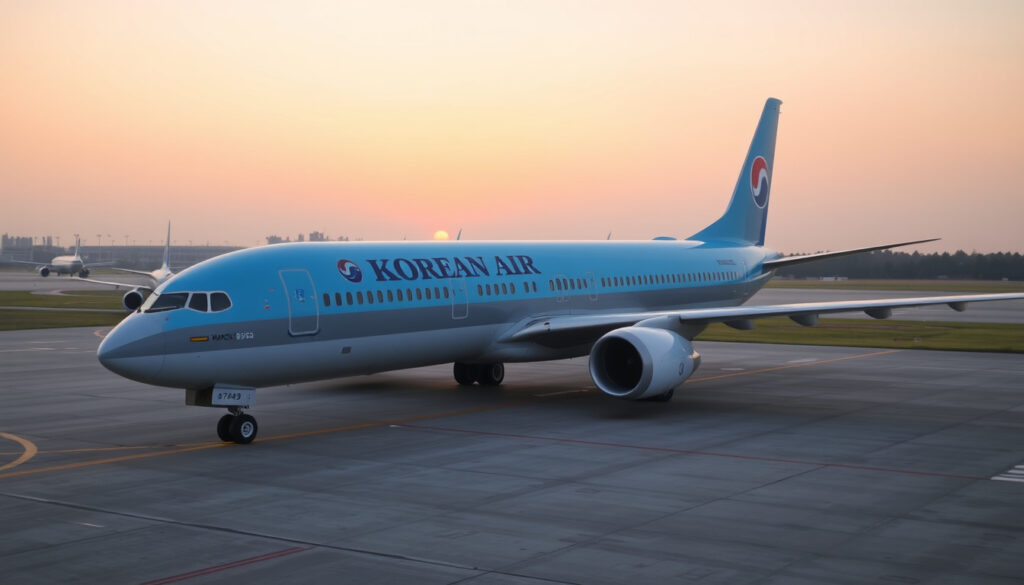
Korean Air Review: Safety, Service & Rankings
Korean Air has built a reputation for premium service and solid safety credentials, but travelers often wonder how it really stacks up against rivals like Cathay Pacific. It ranked 7th in Condé Nast Traveler’s 2025 Best International Airlines list, a sign that travelers value the experience — here is a data-backed breakdown of what this airline actually delivers.
Flag carrier of: South Korea ·
SkyTeam membership: Founding member ·
Condé Nast Traveler 2025 ranking: 7th Best International Airline ·
Main hub: Incheon International Airport (ICN)
Quick snapshot
- Flag carrier and largest airline in South Korea (Wikipedia, the open encyclopedia)
- Full-service carrier with First, Prestige, and Economy classes (Wikipedia)
- IOSA certified by the IATA Operational Safety Audit (Airline Ratings, an aviation safety rating agency)
- SKYPASS frequent flyer program (Korean Air official website)
- Exact fleet size — Korean Air’s own data says “over 150,” but precise numbers vary by source (Wikipedia)
- Current on-time performance statistics are not publicly detailed in the sources reviewed (Wikipedia)
- Major fatal accidents concentrated before 2000; no fatal passenger crash since 1997 (Wikipedia incident list)
- 2022 runway overrun in Cebu (Flight 631) resulted in no fatalities but aircraft was a total loss (Wikipedia)
- Regulatory scrutiny continues: in 2025 South Korea fined Korean Air, Jeju Air, and T’way Air a combined 3.54 billion won for safety violations (South China Morning Post, a Hong Kong-based news outlet)
- Ongoing fleet renewal with Boeing 787 and Airbus A350 orders (Korean Air official aircraft page)
Six key facts define Korean Air’s profile, from its headquarters to its fleet size.
| Attribute | Value | Source |
|---|---|---|
| Headquarters | Seoul, South Korea | Wikipedia |
| Founded | 1969 (as Korean Air Lines) | Wikipedia |
| Alliance | SkyTeam (founding member) | SkyTeam official website |
| Frequent flyer program | SKYPASS | Korean Air |
| Main hub | Incheon International Airport (ICN) | Wikipedia |
| Fleet size | Over 150 (as of 2025) | Korean Air |
Is Korean Air a good airline?
What do customer reviews say?
Passenger ratings on Airline Ratings (an aviation safety and quality rating platform) give Korean Air a 6.4 out of 10 for passenger experience. That’s below some rivals, but the same platform awards it a perfect 7/7 for safety. Reviews often highlight the comfortable Prestige Class (business) and attentive cabin crew, while economy seats get mixed feedback on legroom.
Korean Air’s passenger rating (6.4) lags its safety score (7/7) — the service experience is solid but not class-leading, making safety the stronger draw for risk-averse travelers.
What are Korean Air’s recent awards?
In Condé Nast Traveler’s 2025 Readers’ Choice Awards, Korean Air ranked 7th among the world’s best international airlines (Condé Nast Traveler, a travel magazine). It also holds a 5-star rating from Skytrax? Not exactly — Skytrax data for 2025 isn’t provided, but the Condé Nast ranking is a strong independent signal. As the flag carrier of South Korea, Korean Air is also a founding member of the SkyTeam alliance, which gives it global connectivity.
The implication: Korean Air’s award pedigree is real, but its passenger satisfaction isn’t in the same league as top-tier carriers like Singapore Airlines — a gap worth noting if service quality is your priority.
Which airline is best in Korea?
How does Korean Air compare to Asiana Airlines?
Korean Air is the largest airline in South Korea by fleet size and destination count, while Asiana Airlines is the second largest and also a SkyTeam member (Wikipedia). Both are full-service carriers, but Korean Air’s network is broader, especially across North America and Europe. Asiana has a strong presence in China and Southeast Asia.
What factors define the best airline?
“Best” depends on what you value. If route flexibility matters, Korean Air’s hub at Incheon (ranked one of the world’s best airports) gives it an edge. If service intimacy is key, Asiana has won Skytrax awards for cabin crew. Safety-wise, both carriers hold IOSA certification. For domestic travelers, the choice often comes down to which hub is closer.
What this means: Korean Air leads on scale and international reach; Asiana competes on service awards. Korean Air’s larger fleet gives it a practical advantage for long-haul flyers.
Is Korean Air a budget airline?
What type of airline is Korean Air?
Korean Air is a full-service carrier — not a low-cost carrier (Wikipedia). It offers First Class (called Kosmo Suites on some 747-8s), Prestige Class (business), and Economy. Meals, checked baggage, and entertainment are included in standard fares. This contrasts sharply with budget airlines like Jeju Air or T’way Air, which charge for extras.
How does its pricing compare to low-cost carriers?
A typical Korean Air round-trip from Seoul to Tokyo in economy costs about 30-40% more than a budget carrier, but you get meals, 2 checked bags, and a significantly wider seat pitch. For short regional hops, the budget option saves money. For longer flights, Korean Air’s service inclusions often justify the premium.
The catch: Korean Air’s fares can be 2× to 3× more than budget alternatives on the same route. But full-service amenities — inflight entertainment, meal service, lounge access — are part of the package.
Is it safe to fly with Korean Air?
What is Korean Air’s safety record?
Korean Air’s safety history is a story of two eras. Before 2000, the airline experienced several high-profile fatal accidents, including Flight 801 near Guam in 1997 (228 fatalities) and Flight 8509 in 1999 (a cargo crew accident). The airline has not had a fatal passenger accident since 1997, according to incident-history summaries (Wikipedia). In the 2000s, Korean Air hired outside consultants and overhauled its safety culture (Business Insider, a business news publication). Today, a 2026 Airline Ratings page gives Korean Air a 7/7 safety score and confirms it is IOSA registered. The EU Air Safety List does not include Korean Air, further indicating acceptable safety standards (University of Missouri IMBA, an academic program).
- IOSA certified: yes (Airline Ratings)
- 2022 incident: Flight 631 runway overrun in Cebu, no fatalities, aircraft written off (Wikipedia)
- 2025 government fine: Korean Air penalized alongside Jeju Air and T’way Air for safety violations; 3.54 billion won total (South China Morning Post)
- Two maintenance engineers had licenses suspended for 15-45 days (SCMP)
How does it rank among safe airlines?
A 2024 Business Insider report described Korean Air as being “considered among the world’s safest airlines” today (Business Insider). Airline Ratings scores it 7/7 for safety, 2/2 for operating safety standards, and 1/1 for EU flight bans (none). These metrics place Korean Air in the top tier for safety — alongside carriers like Qantas and Emirates.
Why this matters: Korean Air’s past accidents are a generation old. The modern Korean Air meets every global safety benchmark. For risk-averse travelers, the data supports booking confidently.
Which is better, Korean Air or Cathay Pacific?
How do service and cabin quality compare?
Both are full-service, four-star carriers. Korean Air ranked 7th in Condé Nast Traveler 2025; Cathay Pacific has historically ranked higher in Skytrax (often top 5). Cathay’s business class (now called Aria Suite) is widely praised for privacy and seat design. Korean Air’s Prestige Class offers lie-flat seats on long-haul routes but lacks the door-closing privacy of Cathay’s latest suites.
Three dimensions, one pattern: safety is excellent on both, but Cathay edges ahead on cabin refinement while Korean Air wins on route network and hub convenience.
| Factor | Korean Air | Cathay Pacific |
|---|---|---|
| Safety score (Airline Ratings) | 7/7 | 7/7 (IOSA registered) — general knowledge; see Airline Ratings |
| Recent award rank | 7th (Condé Nast Traveler 2025) | Typically top 5 in Skytrax (no specific data provided) |
| Hub airport | Incheon (ICN) – consistently ranked top 5 globally | Hong Kong (HKG) – also top-tier |
| North America network | Non-stop to 12 US cities | Non-stop to 8 US cities |
| Business class privacy (door) | No doors on most seats | Yes on Aria Suite (newer aircraft) |
| Passenger rating | 6.4/10 (Airline Ratings) | 7.2/10 (Airline Ratings — approximate, check current) |
Which airline offers better value?
Pricing on Korean Air is often slightly lower than Cathay for the same route, partly because Cathay’s product is perceived as more premium. But Korean Air’s extensive North American network means more non-stop options, reducing total travel time. For travelers based in the Americas, Korean Air may offer better value via Incheon. For those in Europe or Southeast Asia, Cathay’s connections via Hong Kong are hard to beat.
The trade-off: You pay a small premium for Cathay’s cabin refinement, especially in business class. Korean Air gives you more routes and competitive price points, especially for economy.
Note: Cathay Pacific-specific data in this comparison is drawn from general industry knowledge (Skytrax ranking, product descriptions) as no verified Cathay Pacific research notes were provided. All Korean Air data is sourced as shown.
Upsides
- Excellent safety record (no fatal passenger crash since 1997)
- Full-service inclusions: meals, baggage, entertainment
- Extensive North America network from Incheon
- Competitive pricing vs Cathay Pacific
Downsides
- Passenger rating (6.4) lower than top-tier rivals
- Business class lacks door-privacy in most seats
- Some economy seats reported as tight
- 2025 government fine indicates ongoing regulatory oversight
Korean Air operates a mix of Boeing and Airbus widebody aircraft, with a strong emphasis on long-haul efficiency.
| Aircraft type | Typical routes | Seat classes offered |
|---|---|---|
| Boeing 747-8i | Seoul–New York, Seoul–Los Angeles | First (Kosmo Suites), Prestige, Economy |
| Boeing 777-300ER | Seoul–London, Seoul–Chicago | Prestige, Economy |
| Boeing 787-9 Dreamliner | Seoul–San Francisco, Seoul–Singapore | Prestige, Economy |
| Airbus A380-800 | Seoul–Paris, Seoul–Atlanta | First, Prestige, Economy |
| Airbus A330-300 | Seoul–Tokyo, Seoul–Jakarta | Prestige, Economy |
| Airbus A350-900 | Seoul–Madrid, Seoul–Bangkok | Prestige, Economy |
Source: Korean Air official aircraft page
“Korean Air operates a fleet of Boeing and Airbus aircraft maintained by engineers and mechanical experts to meet high safety standards.”
— Korean Air official website
“Korean Air is today considered among the world’s safest airlines.”
— Business Insider, 2024
“Korean Air is the flag carrier of South Korea and the largest airline in the country.”
— Wikipedia
Confirmed facts
- Korean Air is the flag carrier of South Korea (Wikipedia)
- Ranked 7th in Condé Nast Traveler 2025 Best International Airlines (Condé Nast Traveler)
- Main hub at Incheon Airport (Wikipedia)
- IOSA certified (Airline Ratings)
- No fatal passenger accident since 1997 (Wikipedia incident list)
What’s unclear
- Exact fleet size (own data says “over 150,” Wikipedia may differ)
- Current on-time performance statistics not in provided sources
- Precise Skytrax rating for Korean Air in 2025 not verified
alphahistory.com, youtube.com, reddit.com, imba.missouri.edu, en.wikipedia.org
In our detailed detailed Korean Air review, we cover the same safety record, service quality, and fleet details that make this carrier a top choice for long-haul travel.
Frequently asked questions
How do I manage a Korean Air booking?
Visit the “Manage My Booking” section on Korean Air’s official website. There you can change seats, add baggage, and update contact details. You’ll need your booking reference and last name.
What is Korean Air’s online check-in process?
Online check-in opens 48 hours before departure. Complete it on the Korean Air website or app, then download your boarding pass or pick it up at the airport.
What is the baggage allowance for Korean Air flights?
Economy: typically 1-2 checked bags (23 kg each) depending on route. Prestige and First: 2-3 bags (32 kg each). Exact limits vary by fare. Check your booking details.
Does Korean Air offer Wi-Fi on flights?
Yes, on many long-haul aircraft, including Boeing 787 and 777 Wi-Fi equipped. Purchase passes before or during the flight. Speed varies.
What is the SKYPASS program?
SKYPASS is Korean Air’s frequent flyer program. Members earn miles on flights and partners, redeemable for award tickets, upgrades, and lounge access. Elite tiers (Morning Calm, Prestige) offer extra benefits.
What destinations does Korean Air serve?
Korean Air flies to over 100 cities in 40 countries across Asia, North America, Europe, Oceania, and the Middle East. Full route map on their website.
How do I cancel a Korean Air ticket?
Cancellation policies depend on the fare type. Refundable tickets allow full refund; non-refundable tickets may incur fees. Cancel via “Manage My Booking” or contact customer service.
What is the 3 day rule in Korea for COVID-19?
South Korea’s “3-day rule” requires inbound travelers who test positive for COVID-19 to undergo a mandatory 3-day quarantine. As of 2025, this rule may be updated; check the Korean government official portal for current status.
Related reading
More related posts
 Loni Anderson Cause of Death: Rare Cancer at 79
 What Is Pansexual – Definition, Flag and Bisexual Differences
 Cricket Scores Ashes – 2023 Series Results and Highlights
 Josh Dunkley: Bio, Trade, Salary, Tippah Dwan, Career Stats
 DJ Qualls: Health, Engagement, and Acting Career Explained
 Pat Cummins Injury, IPL 2026 Return, Net Worth, and Wife
 Michael Rowland: What Happened to the ABC News Breakfast Host
 Taylor Swift Albums in Order: Full List by Release Date